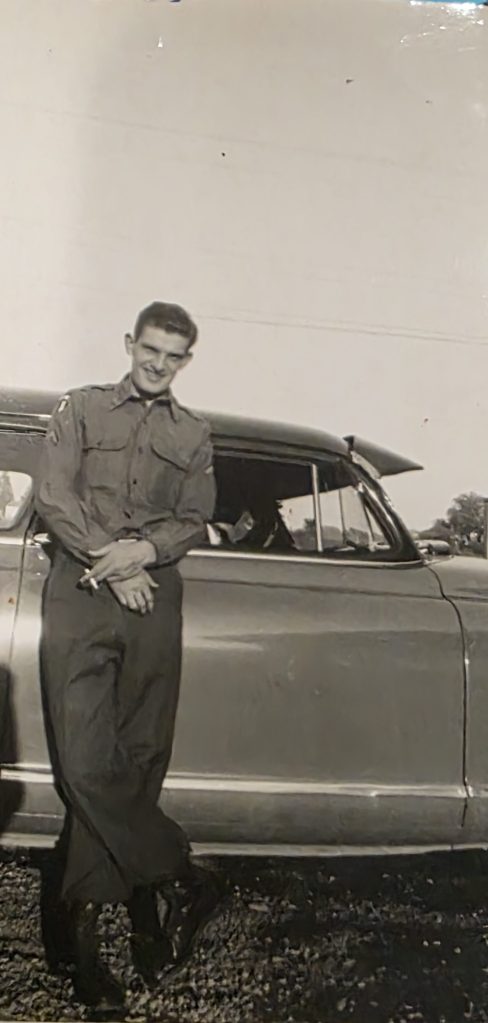
Category: Family History

  • Dillard C. Howell: The Brother Who Came Home

    Dillard C. Howell: The Brother Who Came Home

    Gettysburg, Point Lookout, and the Family He Built After the Civil War

    On April 14, 1865, twenty-two-year-old Dillard Charles Howell arrived at Point Lookout, Maryland, as a Confederate prisoner of war. Eight days earlier, Union soldiers had captured him near Burkesville, Virginia. General Robert E. Lee had surrendered at Appomattox on April 9, but Dillard was not yet free.

    The prison held a painful connection to his family. His brother Lorenzo Dow Howell had died there before Dillard arrived. Two brothers from the mountains of southwestern Virginia had entered the Confederate Army. Both became prisoners, and both were connected to Point Lookout. Only Dillard would return to civilian life.

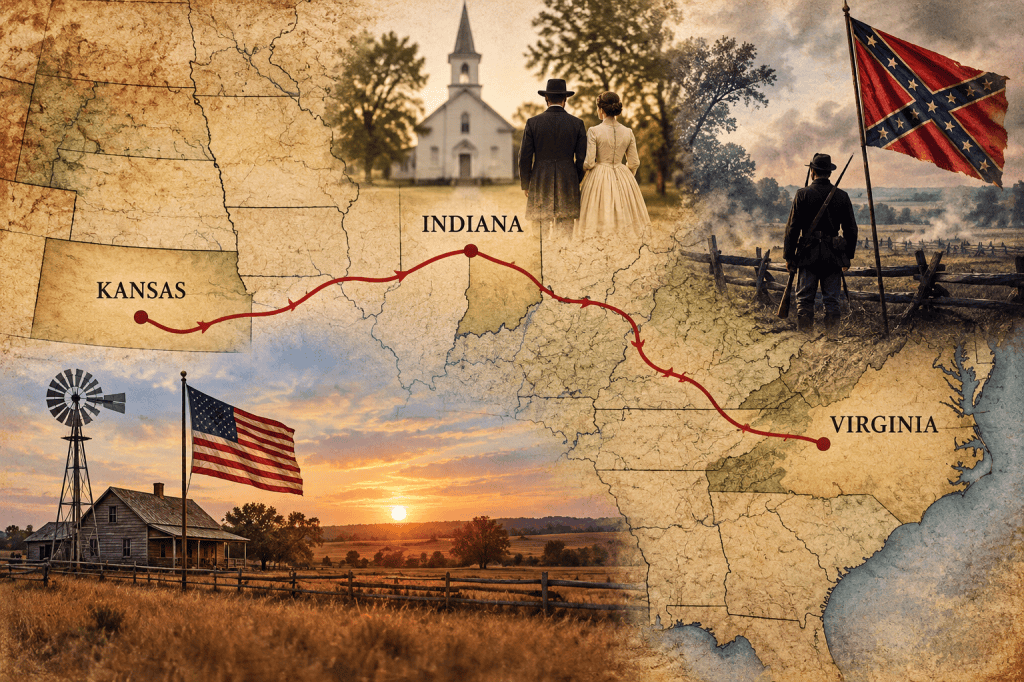
    What happened after his release is as important as what happened during the war. Dillard would marry in Indiana, raise a family, settle in Kansas, and live long enough to tell a newspaper reporter what he remembered about Gettysburg fifty years earlier.

    From Floyd County to the Army
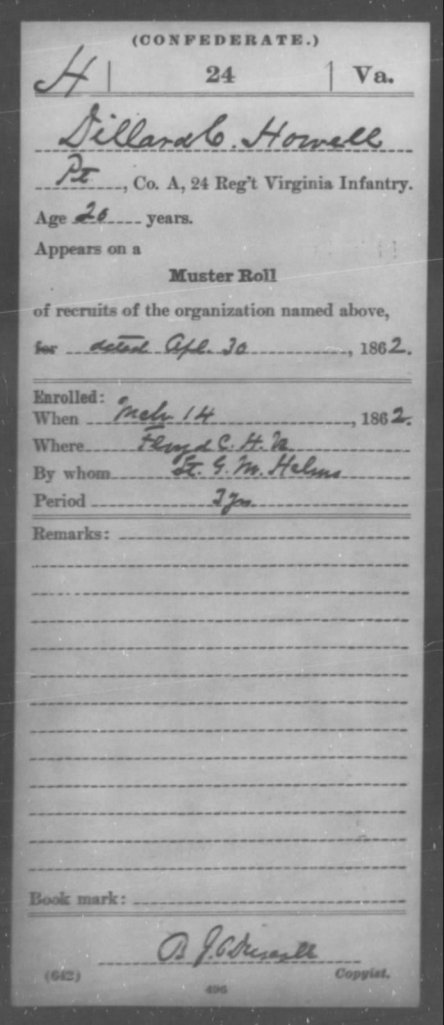
    Military service record identifying Dillard C. Howell as a private in Company A, 24th Virginia Infantry.

    Dillard was born September 10, 1842, in Floyd County, Virginia, a son of Isaac Howell and grandson of David Howell. The family descended from Joshua Howell, an ancestor whose descendants would appear in the records of several American wars.

    When the Civil War began in 1861, Dillard was eighteen. On March 14, 1862, he enlisted in Company A of the 24th Virginia Infantry, a company associated with the Floyd Riflemen. The regiment recruited from Floyd and neighboring southwestern Virginia counties and served in the Army of Northern Virginia.

    Dillard’s compiled military service record identifies him as a private. Muster rolls trace his service through years of campaigning. An 1863 entry identifies him as a blacksmith’s assistant, a practical assignment in an army dependent on horses, wagons, and equipment that constantly needed repair.

    That small detail is worth remembering. An ancestor’s military life was not necessarily a continuous series of battles. Much of it involved labor, marching, waiting, and trying to remain supplied.

    Research tip — Read every service-record card. An enlistment index tells only part of the story. Compiled military service records can include muster rolls, pay information, hospital entries, clothing receipts, and notes about special duties. Compare dates across the entire file before deciding where a soldier was or what he was doing.

    Gettysburg in Dillard’s Own Memory
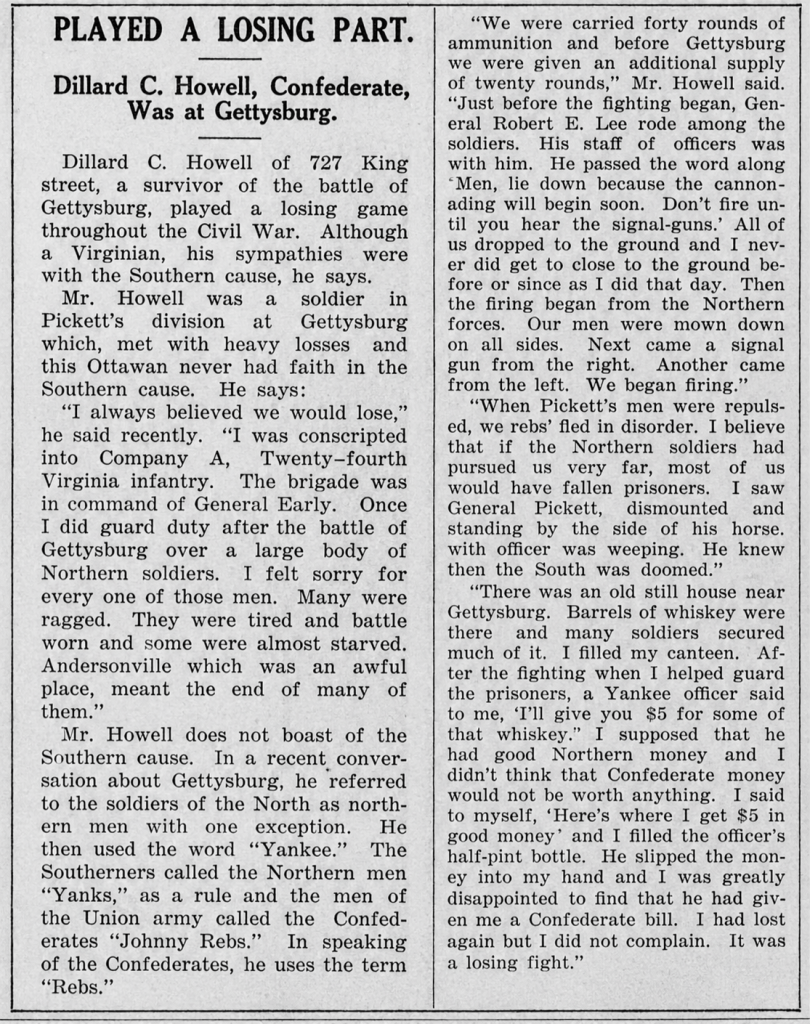
    **Dillard C. Howell recalls the Battle of Gettysburg.** In an interview published in *The Evening Herald* (Ottawa, Kansas), June 30, 1913, page 6, Howell described his experiences during Pickett’s Charge fifty years after the battle. The original newspaper columns have been rearranged for easier reading.

    In July 1863, the 24th Virginia entered the Battle of Gettysburg as part of Brigadier General James L. Kemper’s Brigade in Major General George E. Pickett’s Division. On July 3, the regiment took part in the Confederate assault on the Union center, remembered as Pickett’s Charge.

    The attack was catastrophic. The 24th Virginia had approximately 395 men at Gettysburg and suffered casualties approaching forty percent of those engaged. Dillard survived, but the experience stayed with him for the rest of his life.

    In 1913, an Ottawa, Kansas, newspaper published an interview under the headline “PLAYED A LOSING PART — Dillard C. Howell, Confederate, Was at Gettysburg.” By then he was an elderly man who had spent decades building a civilian life far from Pennsylvania.

    Dillard remembered soldiers receiving additional ammunition before the assault. He recalled General Lee riding among the troops and warning them to lie down before the cannonading began. Then came the bombardment and the advance toward the Union line. He described men falling around him as Confederate formations crossed open ground under intense fire.

    The assault failed. The surviving soldiers withdrew, leaving thousands dead, wounded, or captured across the battlefield. Dillard also remembered seeing General Pickett after the fighting and an officer overcome with emotion. These were memories recorded half a century later, not a minute-by-minute contemporary account, but they offer something muster rolls cannot: a soldier’s perspective.

    His interview also preserved a surprisingly humorous encounter. Dillard recalled obtaining whiskey and later accepting five dollars from a Union officer for some of it, only to discover that he had been paid in Confederate currency. He could still appreciate the joke decades afterward.

    Most striking was his assessment of the Confederate cause: “I always believed we would lose.” Rather than offering a triumphant battlefield tale, Dillard remembered an army that had suffered a terrible defeat. His words deserve to be read in the context of a war fought over secession and the preservation of slavery, even as his individual experience helps us understand the human cost of that conflict.

    Research tip — Search anniversary newspapers. Fifty-year battle anniversaries and veterans’ reunions often prompted interviews that preserved first-person recollections. Search newspapers where your ancestor lived later, not only where the battle occurred. Try the soldier’s initials, regiment, hometown, and words such as “veteran” or “reunion.”

    Capture and the Prison Where Lorenzo Died
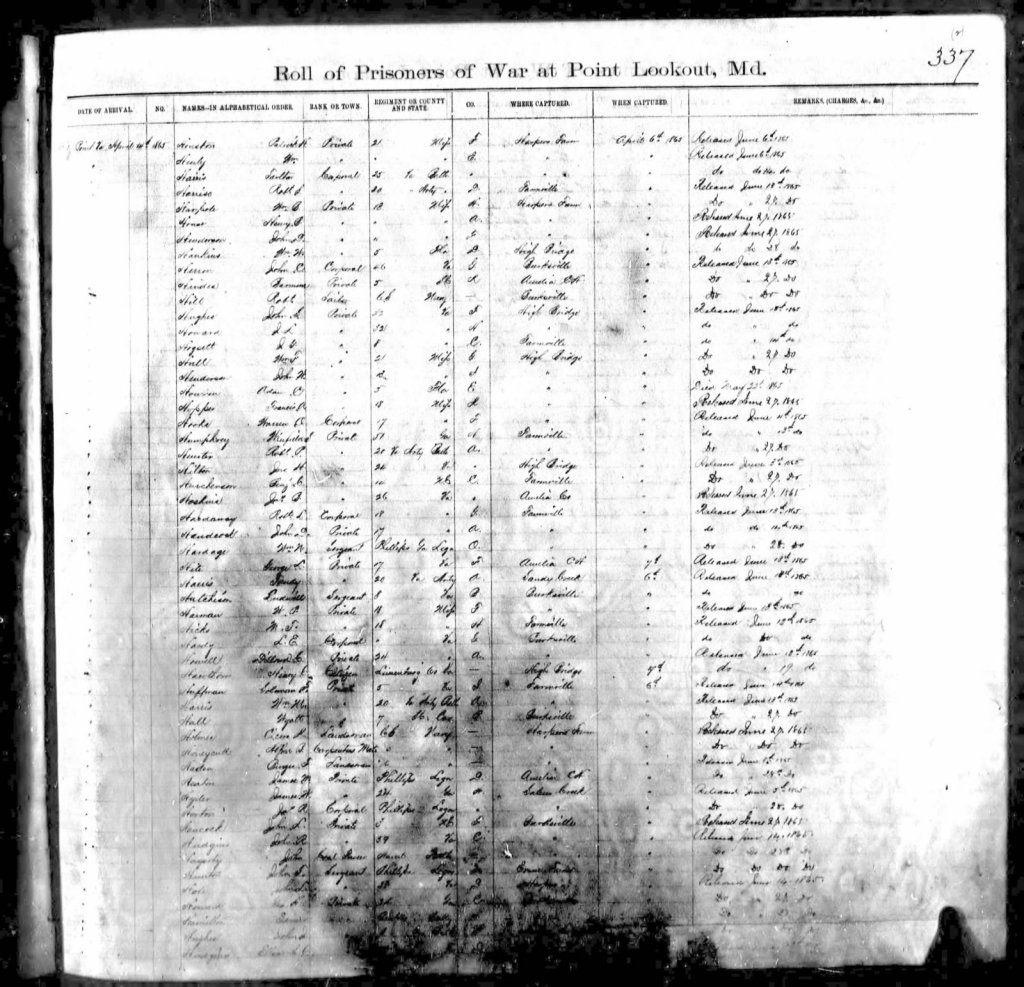
    **Dillard C. Howell’s prisoner-of-war record, 1865.** This register from Point Lookout, Maryland, documents Confederate prisoners held during the final months of the Civil War. Howell was captured near Burkesville, Virginia, on April 6, 1865, arrived at Point Lookout on April 14, and was released on June 13, 1865. *Roll of Prisoners of War at Point Lookout, Maryland*, page 337.

    The 24th Virginia continued serving after Gettysburg, including in the long campaigns around Petersburg. By April 1865, Lee’s army was retreating westward under mounting Union pressure.

    Dillard’s prisoner-of-war record states that he was captured at Burkesville, Virginia, on April 6, 1865. He arrived at Point Lookout eight days later. The camp stood at Maryland’s southern tip, where the Potomac River meets the Chesapeake Bay. Thousands of Confederate prisoners were confined there, and disease, exposure, and overcrowding contributed to many deaths.

    Among those who had died was Lorenzo Dow Howell, Dillard’s brother. Lorenzo’s own article in this series tells the story of his service and death. Here, the crucial fact is the timing: Lorenzo was already dead when Dillard reached Point Lookout.

    We cannot say from the records examined whether Dillard knew that news before his arrival, learned it in prison, or visited his brother’s burial place. Inventing such a scene might make dramatic reading, but it would not make sound family history.

    On June 13, 1865, Dillard was released from Point Lookout, Maryland, according to his prisoner-of-war records. The prison paperwork recorded Floyd County as his residence and included a physical description: light complexion and hair, gray eyes, and a height of approximately five feet nine inches.

    One brother had died in captivity. The other walked away from the camp and into a changed country.

    Research tip — Follow the prisoner trail. Capture cards, prison registers, transfer records, and oaths of allegiance may supply different dates and personal details. Compare each document rather than assuming that the capture date, prison arrival date, and release date describe one event.

    A Marriage in Indiana
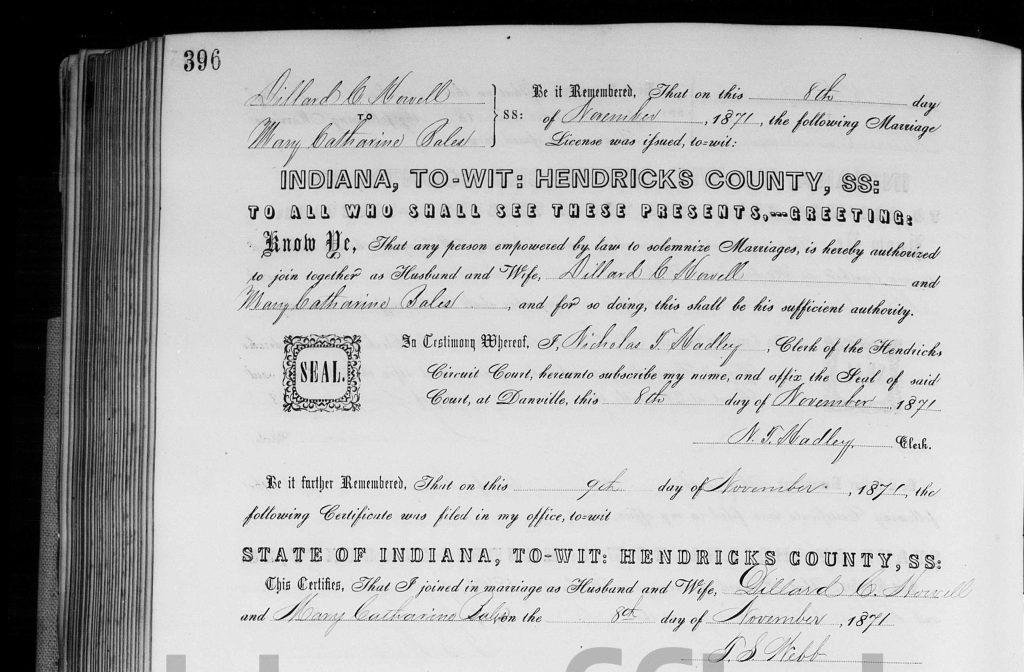
    Marriage of Dillard C. Howell and Mary Catharine Bales, November 8, 1871. Their marriage was recorded in Hendricks County, Indiana, six years after Dillard’s release from Point Lookout. This original marriage record provides an important link between his military service in Virginia and his later family life in Kansas.

    Six years after his release, Dillard’s life took a new direction. On November 8, 1871, Dillard C. Howell married Mary Catharine Bales in Hendricks County, Indiana. Their marriage record anchors him in a place between his wartime Virginia home and the Kansas community where he later lived.

    The couple went on to raise five children identified in the family records: Victoria Florence Howell, born in 1873; Henrietta J. Howell, born in 1874; Lorenzo Dow Howell, born in 1879; James Howell, recorded under the names James Emmett and James Everett, born in 1883; and Charles E. Howell, born in 1888.

    The younger Lorenzo’s name carried an unmistakable family connection. Dillard had lost his brother Lorenzo Dow Howell at Point Lookout. Years later, he and Mary gave their son that same name. No surviving statement tells us exactly why they chose it, but the repetition suggests that his brother’s memory remained close.

    A later newspaper notice referred to a son named Everett Howell, who worked at the Illinois State Hospital in Peoria, Illinois. The family’s other records identify James as James Everett, resolving the apparent discrepancy: Everett was not an additional sixth child.

    Research tip — Track names and migration together. A marriage record can place an ancestor between census years. Follow it with children’s birthplaces, census entries, directories, and land records to reconstruct a family’s route. Also remember that a person may appear under a first name, middle name, nickname, or initials. Check relationships and occupations before creating a second person in your family tree.

    A Familiar Figure in Ottawa
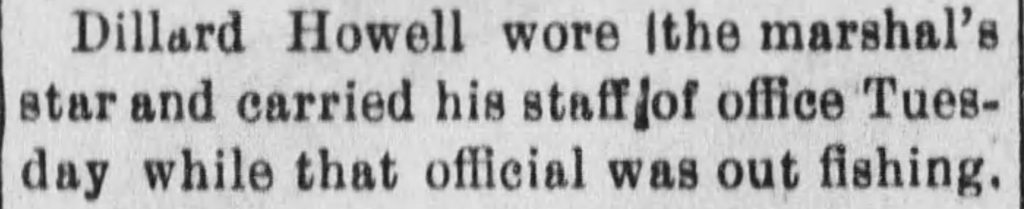
    **Dillard Howell temporarily serves as city marshal, 1905.** According to *The Osawatomie Graphic* (Osawatomie, Kansas), May 25, 1905, page 8, Howell wore the marshal’s star and carried his staff of office while the official was away fishing. This brief newspaper notice offers a glimpse into Dillard’s civilian life forty years after the Civil War.

    Dillard and Mary eventually settled in Ottawa, Franklin County, Kansas. A 1903 city directory listed them at 737 King Street, while later records placed them at other addresses in town. These changing entries help trace the household through time.

    Local newspapers reveal a life that was not defined solely by the Civil War. In 1905, Dillard temporarily carried the city marshal’s badge and staff of office while the marshal was away fishing. Another report described his involvement in arresting two men found with suspicious tools. In 1912, he was appointed to replace a departing night watchman.

    Family notices provide quieter glimpses. Dillard and Mary visited their son Lorenzo and his family. A 1915 report mentioned Everett’s visit from Illinois. Another notice identified a married daughter as Mrs. Dwight Brown, a clue for following the daughters after their surnames changed.

    Such short newspaper items may seem ordinary beside a battlefield interview, but they reveal the decades that made up most of Dillard’s life: work, family visits, and relationships with neighbors.

    Research tip — Do not ignore the social columns. A few lines about a visit, wedding, job, or illness can establish relationships and locations missing from official records. Search spouses and married daughters as carefully as the person whose surname you are tracing.

    An Old Soldier Looks Back

    In 1913, Gettysburg’s fiftieth anniversary brought Union and Confederate veterans back into public attention. A Franklin County newspaper identified ten local Gettysburg veterans, including seven former Union soldiers and three former Confederates. Dillard, listed as a veteran of Company A, 24th Virginia Infantry, was one of the three.

    He did not attend the anniversary reunion, but his newspaper interview preserved his memories. It is remarkable that the same man whose military record lists him as a young private in 1862 was still speaking about his experiences in 1913, in a Kansas town far from his birthplace.

    Dillard died on September 5, 1936, in Franklin County, Kansas, five days before his ninety-fourth birthday. He was buried at Prairie City Cemetery near Baldwin City. Mary survived him and died in 1952.

    He had lived through the Civil War, Reconstruction, westward expansion, the First World War, and the Great Depression. Yet one thread linked the young soldier to the elderly husband and father: the name Lorenzo Dow Howell, passed from the brother who died to the son who grew up after the war.

    The Next Howell Story

    Dillard’s story follows Lorenzo’s in our journey backward through the family’s military history. It shows not only how one man survived war and imprisonment, but how his life continued through marriage, children, work, and remembrance.

    The next chapter reaches into an earlier generation. Dillard’s father, Isaac Howell, had a sister, Nancy Ann Howell, born October 26, 1791, in Montgomery County, Virginia. Her story brings us to the era of the War of 1812.

    Military files can tell us when an ancestor served. Newspapers may tell us what that person remembered. Marriage records and census entries reveal the family that followed. The richest family stories emerge when we bring those sources together without pretending they answer every question.

    Lorenzo Dow Howell never returned from Point Lookout. Dillard did. And in the family he built afterward, his brother’s name lived on.


    Historical Note: This story is part of a continuing series exploring the Howell family’s military legacy across generations. It is based on family records, military records, historical sources, and documented family research. Some narrative details are included to place those records within their historical setting. Where surviving records do not establish an exact location, event, or circumstance, the narrative should be understood as historical context rather than a statement of documented fact.

    AI Generated Artwork

  • The Roadside Ghosts of the A4: The Day My Family’s Past and Future Collided

    The Roadside Ghosts of the A4: The Day My Family’s Past and Future Collided

    Every soldier knows that the military is built on a foundation of unspoken connections. We wear the patches of campaigns fought before we were born, and we walk the parade grounds where legends once stood. But sometimes, history doesn’t just echo—it pulls over to the side of the road and stares you right in the face.

    The only reason I am writing this today is because of a story my wife, Stephanie, recently wrote. She spent countless hours digging through old genealogy records and parsing through World War I military morning reports, meticulously tracing my grandfather’s travels through France. Because of her research, the invisible threads of our family tree suddenly became a map.

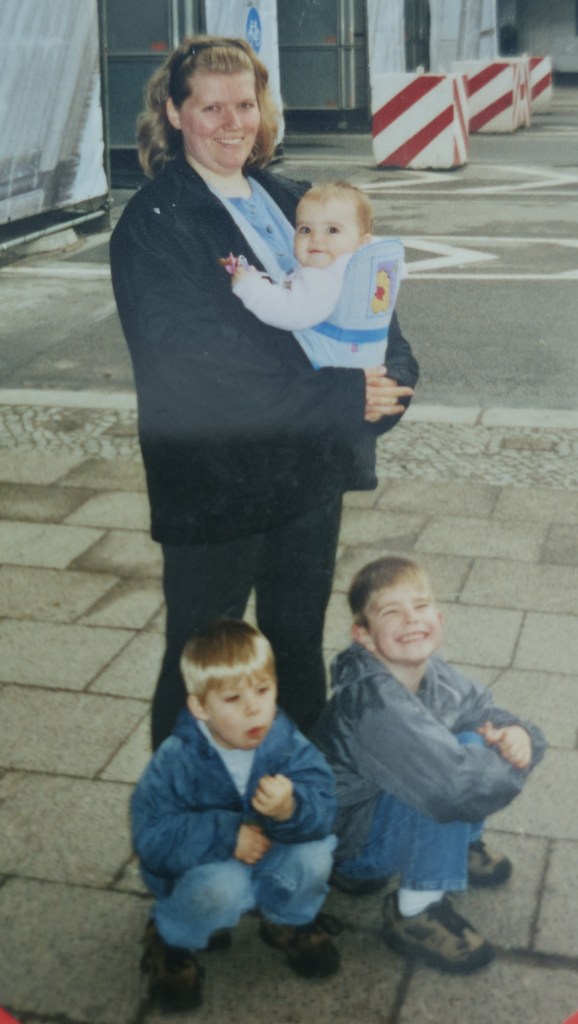
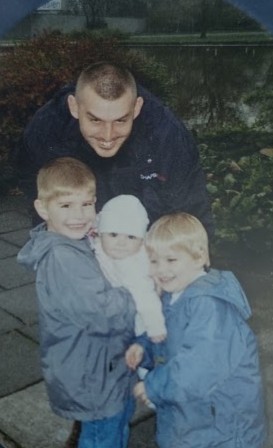
    In 2002, I was stationed at Conn Barracks in Schweinfurt, Germany. I was serving in C Troop, 1/4 Cavalry, 1st Infantry Division. Like any young dad with a bit of leave, I loaded up the family car for a European road trip. Stephanie, our 1-year-old daughter, my 6-year-old son, Robert, and my 4-year-old son, Jonathan, all piled in.

    Stephanie with our children during our family trip to Berlin in 2002.

    Our destination was Normandy. As a veteran, I was intent on experiencing the D-Day beaches, wanting to stand where the Greatest Generation cracked Hitler’s Atlantic Wall in 1944. We drove out of Germany, passed through Luxembourg City, and headed up into Belgium. Along the way, I spotted a cluster of old, concrete wartime pillboxes sitting silently near the tree line.

    Captivated by the history, I pulled the car over. Stephanie stayed back with our baby girl while I took both of my young boys, Robert and Jon, by the hand. We walked right out to those cold, moss-covered fortifications, exploring the old firing slits and touching the concrete together. I didn’t know the exact history of those specific bunkers at the time; I just wanted my boys to see a piece of the world their country had fought to free.

    Joseph Howell with his three children during a family visit to Berlin in 2002.

    After a few minutes, we saddled back up and continued our journey to the coast.

    The trip was incredible, but it was the drive back to Schweinfurt that secretly held the real magic.

    Leaving Paris, we took the A4 highway, the Autoroute de l’Est, heading eastbound back toward Germany. It was a peaceful, scenic drive. My family was safe, free, and buckled into the back seat. I was just focused on the road, completely unaware of the geography passing outside my window.

    I didn’t know it then. I wouldn’t find out until Stephanie cracked open the archives this year.

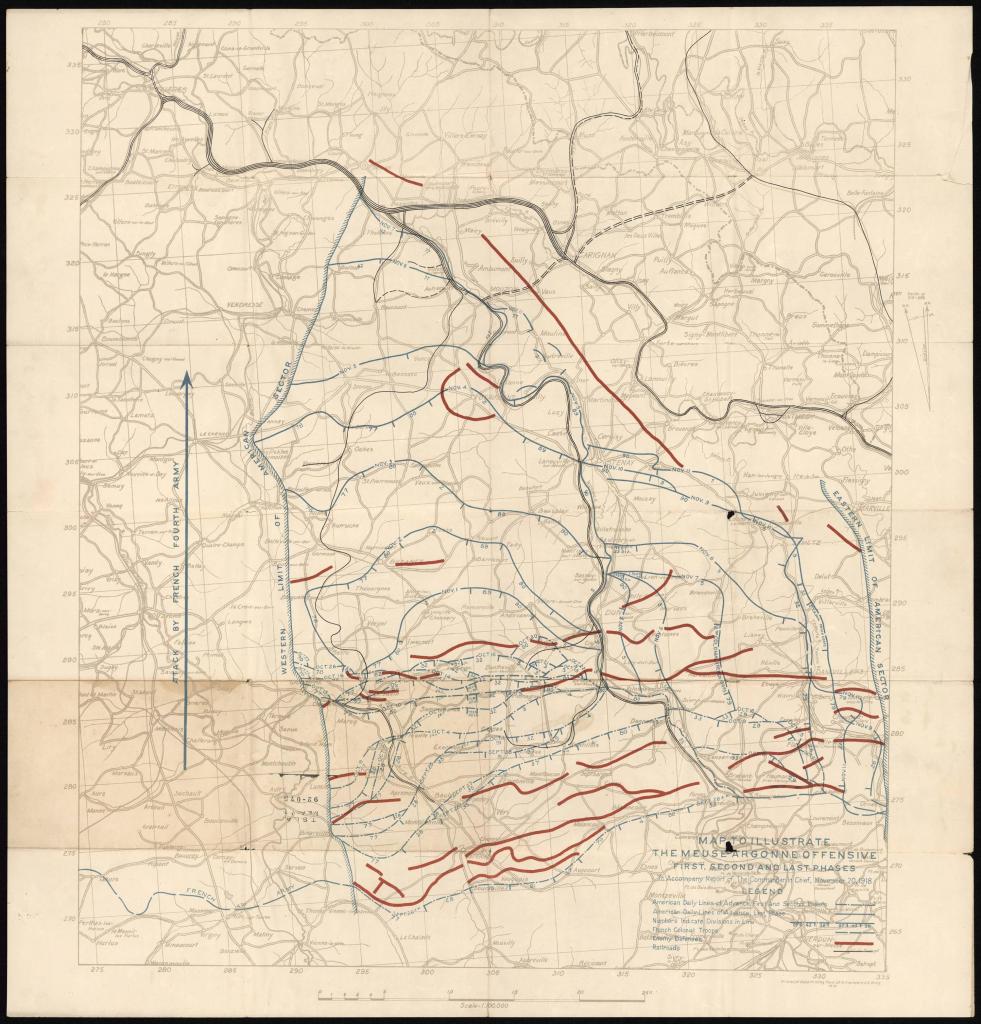
    As our tires rolled down the A4, we were traveling through the Argonne region. We passed Sainte-Menehould and continued toward Verdun, through countryside intimately connected with the battlefields of the First World War. Somewhere north of our route lay the ground over which American soldiers had fought against the heavily fortified German defensive system known as the Kriemhilde Stellung.

    And that is where the timeline folds in on itself.

    Map of the Meuse-Argonne Offensive showing the American advance through northeastern France in 1918. Library of Congress.

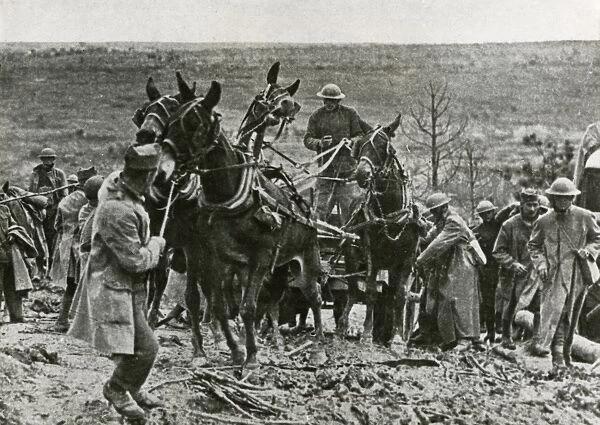
    In October 1918, my grandfather—and my exact namesake—Joseph Robert Howell was serving in that campaign. He was an artilleryman with the 150th Field Artillery, part of the 42nd “Rainbow” Division, as American forces fought to break through the German defenses during the Meuse-Argonne Offensive.

    During that fighting, the 42nd Division moved into the line and relieved a battered division that had suffered heavily while fighting across those ridges.

    That unit was the 1st Infantry Division.

    Guns and horses of the 150th Field Artillery, 42nd “Rainbow” Division, waiting to move toward the front in France during World War I. Library of Congress.

    The Big Red One.

    My unit.

    During the final weeks of the war, my grandfather was severely wounded. He survived those wounds, came home, and passed his name down to me.

    Decades later, the Army sent me across the Atlantic to serve in the exact division his division had relieved, proudly walking in the lineage of the 4th U.S. Cavalry—the very regiment his brother George had served in back in 1911.

    But that is a story for another time, a masterclass in connecting the dots in genealogy.

    Driving down that highway in 2002, I missed the chance to consciously connect with him. I didn’t pull over. I didn’t know to look out the window and whisper a thank you. Realizing now just how close I had unknowingly come to the battlefield where he fought, I’ll admit it brings chills to my arms and tears to my eyes.

    But I didn’t miss the connection.

    Not really.

    Because Joseph Robert Howell was in the mud of France in 1918, enduring the artillery, gas, and misery of one of the final campaigns of the First World War, so that eighty-four years later, his grandson could drive his own children through those same valleys in absolute peace.

    And the ultimate victory? The proof that the warrior gene never left our bloodline?

    Years after that roadside stop, that same legacy of military service would quietly wake up in the next generation. One of those small boys who stood with me at those old concrete bunkers would grow up to put on the uniform himself, stepping forward to lead soldiers on the front lines today. The tradition endures, carrying the family’s quiet dedication to duty forward into a third century.

    We didn’t know it in 2002, but as we drove down the A4, the past, the present, and the future of our family were all riding in the exact same car.


    Historical Note: This story is part of a continuing series exploring the Howell family’s military legacy across generations. It is based on family records, military records, historical sources, and documented family research. Some narrative details are included to place those records within their historical setting. Where surviving records do not establish an exact location, event, or circumstance, the narrative should be understood as historical context rather than a statement of documented fact.

  • Building the Airfields of Victory: The Story of the 1877th Engineer Aviation Battalion

    Building the Airfields of Victory: The Story of the 1877th Engineer Aviation Battalion

    Like many families of World War II veterans, ours was left with more questions than answers. My father, Robert Gordon Howell, rarely spoke about his wartime service, and many of the details of his military career remained unknown after he returned home. It was only years later, after I began researching his service and obtaining his military records, that one designation repeatedly appeared: Company C, 1877th Engineer Aviation Battalion. At first, those words were little more than numbers and letters on official documents. They identified the unit in which he served, but they revealed nothing about where he had been, what he had done, or how the men of the 1877th contributed to Allied victory. Those questions became the beginning of a research journey that continues today.

    As a genealogist and family historian, I learned long ago that one of the best ways to understand an individual service member’s experience is by studying the history of the unit in which he served. While a unit history cannot tell the complete story of one soldier, it can provide valuable insight into where he served, the conditions he endured, and the work performed by the men beside him. With that understanding, I began researching the wartime history of the 1877th Engineer Aviation Battalion.

    The 1877th Engineer Aviation Battalion was part of the U.S. Army Corps of Engineers, but its mission differed greatly from the combat aircrews it eventually supported. While Army Air Forces pilots flew bombing missions and fighter escorts, engineer aviation battalions built the airfields from which those aircraft operated. Their responsibilities extended far beyond simply constructing runways. They built taxiways, roads, drainage systems, electrical and water utilities, hangars, barracks, maintenance facilities, and countless other structures needed to support military aviation. Without the work of engineer aviation battalions, many of America’s air campaigns during World War II would never have been possible. ¹

    One of the best contemporary accounts of the battalion’s wartime service appeared in the December 6, 1945, issue of Roundup, the official newspaper of the China-Burma-India Theater. According to that article, the 1877th departed the United States in late 1943 and began a long journey across the globe. Traveling through Casablanca, Algiers, and Oran in North Africa, the battalion finally arrived at Bombay, India, on February 14, 1944. Nearly two months had passed since the men had left home. There was little opportunity to rest. Only three days after arriving in India, they were already at work constructing a new airfield at Chakulia. ²

    Chakulia was far more than another construction project. It became one of several airfields developed as part of Operation Matterhorn, the Allied plan to launch B-29 Superfortress bombing missions against Japan from bases in India and China. The B-29 represented the most advanced heavy bomber of the war, but its tremendous size and weight required runways that were both longer and stronger than those built for earlier aircraft. Before the first B-29 could begin combat operations, engineer aviation battalions had to create the airfields capable of supporting them. ³

    The accomplishments of the 1877th Engineer Aviation Battalion at Chakulia were nothing short of extraordinary. According to the battalion’s wartime account, the men constructed a 7,500-foot runway, poured approximately 10,000 cubic yards of concrete, moved nearly 400,000 cubic yards of earth, applied 25,000 gallons of asphalt seal, installed more than 400,000 feet of electrical wire, and built water systems, housing for approximately 3,000 men, hangars, and numerous support buildings. ² Even by today’s standards, those figures are impressive. In 1944, they were achieved under conditions that tested the endurance, skill, and determination of every man in the battalion.

    Bob Howell and unknown soldier, CBI Theater cica 1944-45

    Working conditions were often harsh. Construction crews labored in oppressive tropical heat with limited equipment and supplies. The battalion’s own history recalled that meals were frequently delivered directly to the construction site so work could continue without interruption. Heavy machinery arrived slowly, forcing engineers to improvise until additional equipment reached India. Official Army Air Forces histories likewise describe the shortages of construction equipment and the enormous logistical challenges facing engineer aviation units during the early stages of Operation Matterhorn. ² ³

    The successful completion of the Chakulia project earned the battalion a Meritorious Unit Citation, recognizing the exceptional quality of its engineering work. More importantly, the completed airfield became an important operating base supporting B-29 missions during Operation Matterhorn. ²

    The battalion’s work at Chakulia had scarcely been completed before new orders arrived. According to Roundup, Company A moved north to Sahmaw, where engineers first cleared unexploded bombs before beginning construction of a fighter and cargo airfield. Headquarters and Service Company, together with Companies B and C, traveled through Dinjan, India, where heavy construction equipment was dismantled and prepared for transport aboard C-46 and C-47 aircraft. The article reported that 324 transport sorties were required simply to move the battalion’s remaining personnel and equipment into the Myitkyina area. ²

    Near Myitkyina, the battalion continued its engineering mission by helping construct the Namponmao (West Strip) Airfield. Official Army Air Forces histories record that by January 1945, Namponmao had become an all-weather airfield supporting transport aircraft, fighter operations, medical evacuation flights, and the continuing Allied advance through Burma toward China. ³ ⁴

    Working alongside engineers from other aviation battalions, the men of the 1877th Engineer Aviation Battalion endured far more than difficult construction assignments. Throughout their service in India and Burma, they battled oppressive tropical heat, monsoon rains, mosquitoes, disease, primitive living conditions, and the constant threat of enemy air attack. While the bomber crews who flew from these airfields often received the public recognition, the engineers who built them quietly carried out a mission just as essential to Allied success. Every runway completed, every bridge constructed, every drainage ditch dug, and every utility line installed helped move supplies, launch aircraft, evacuate the wounded, and support the advance toward victory.

    By late 1945, with the war drawing to a close, the battalion’s work in the China-Burma-India Theater had come to an end. According to Roundup, the men began their journey home through Karachi, bringing to a close a wartime route that had carried them from the United States through North Africa, across India, and into the jungles of Burma. ² Like so many American servicemen, they returned home with memories and experiences that few outside their unit could fully understand.

    For my family, however, the story of the 1877th Engineer Aviation Battalion is much more than another chapter in military history. It is part of my father’s story.

    When I first began researching his military service, Company C, 1877th Engineer Aviation Battalion was little more than a designation on a government record. Today, those same words represent thousands of miles traveled across three continents, countless hours of labor under some of the harshest conditions imaginable, and a unit whose work helped make one of the most ambitious air campaigns of World War II possible.

    Although I may never know every detail of my father’s wartime service, studying the history of the battalion has allowed me to better understand the world in which he served. It has transformed a simple unit designation into the story of men whose determination, skill, and perseverance helped build the foundations of Allied victory.

    The history of the 1877th Engineer Aviation Battalion also serves as a reminder that history is often written through the actions of ordinary men performing extraordinary work. They were not seeking recognition or fame. They simply carried out the mission before them, knowing that every completed airfield would help save lives and bring the war one step closer to its end.

    As I continue researching my father’s military service, I know there are many more stories waiting to be uncovered. This is only one chapter in his journey, but it is a chapter that has given me a far greater appreciation for what he and his fellow soldiers accomplished during World War II.

    Researching the history of the 1877th Engineer Aviation Battalion has reminded me that victory was achieved not only by the men who flew the aircraft or fought on the front lines, but also by the engineers whose work made those victories possible. Every record I uncover deepens my appreciation for my father’s generation and the sacrifices they made in places that are often forgotten today. This is only one chapter of his military story, but it is one more reminder of why the men and women of World War II will forever be remembered as the Greatest Generation.

    We will remember them.

    Footnotes

    1. National Museum of the U.S. Air Force, “Origins of Engineer Aviation Battalions,” accessed August 2, 2026, https://www.nationalmuseum.af.mil/Visit/Museum-Exhibits/Fact-Sheets/Display/Article/3526447/origins-of-engineer-aviation-battalions/.
    2. Sgt. Ray Howard, “1877th Built Fields Amid Record Heat,” Roundup (China-Burma-India Theater), December 6, 1945, accessed August 2, 2026, https://www.cbi-theater.com/roundup/roundup120645.html.
    3. Wesley Frank Craven and James Lea Cate, eds., The Army Air Forces in World War II, vol. 5, The Pacific: Matterhorn to Nagasaki (Washington, D.C.: Office of Air Force History, 1953), accessed August 2, 2026, https://media.defense.gov/2010/Nov/05/2001329890/-1/-1/0/AFD-101105-012.pdf.
    4. Wesley Frank Craven and James Lea Cate, eds., The Army Air Forces in World War II, vol. 5, Chapter 6, HyperWar edition, accessed August 2, 2026, https://www.ibiblio.org/hyperwar/AAF/V/AAF-V-6.html.

    This article is part of my ongoing research into the military service of my father, Robert Gordon Howell, who served with Company C, 1877th Engineer Aviation Battalion during World War II. As new records become available, this article may be updated to reflect additional discoveries.

  • Finding My Father’s Missing Morning Reports

    One of the biggest challenges in military genealogy isn’t always finding the record—it’s figuring out where the record is located. That was exactly the situation I found myself in while researching my father, Robert Gordon Howell, and trying to document the two times he was hospitalized while serving with Company C, 1877th Engineer Aviation Battalion during World War II.

    Like many researchers, the first place I turned was Fold3.com (https://www.fold3.com), a subscription website owned by Ancestry.com that specializes in military records. I was excited, thinking I would quickly locate my father’s Morning Reports. Unfortunately, I soon discovered that Fold3’s current Morning Report collection only extends through 1939, well before my father’s World War II service.

    For a short time, I thought I had reached a dead end.

    Fortunately, I kept searching.

    While exploring the National Archives and Records Administration (NARA) website (https://www.archives.gov), I discovered that many Army Morning Reports through December 1944 have been digitized in the National Archives Catalog. Instead of searching by a person’s name, you search by the month and year, then browse the Morning Reports for the unit you are researching. The key is knowing the soldier’s unit designation and company. In my father’s case, that meant the 1877th Engineer Aviation Battalion, Company C.

    Armed with that information, I was able to locate exactly what I had been searching for.

    The Morning Reports documented both of my father’s hospitalizations. The first occurred from August 9–17, 1944, and the second from November 15–22, 1944. The reports recorded the day he left his unit for the hospital and the day he returned to duty. Although each entry consists of only a few lines, those few lines confirmed important events in his military service that I had never been able to document before.

    As I continued reading the November Morning Reports, another discovery caught my attention. On the report dated November 22, 1944, five soldiers—including my father—were mentioned. Several of the men were listed as being promoted from Private to Private First Class (PFC). That immediately made me wonder when my father eventually earned his promotion to Technician Fifth Grade (Tech 5).

    Naturally, I wanted to keep reading.

    That’s when I encountered another obstacle. The digitized Morning Reports currently available online end with December 1944. The 1945 reports I need, along with the reports from my father’s Korean War service between 1953 and 1958, have not yet been digitized.

    But instead of looking at that as bad news, I see it as my next adventure.

    Now I have a great excuse to take a genealogy road trip to St. Louis, Missouri, and spend time at the National Archives at St. Louis, where the original Morning Reports are preserved. Once I identify the units my father served with during his later military career, I’ll be able to examine those records in person. My hope is that the 1945 Morning Reports will tell me exactly when he was promoted to Tech 5, while the Korean-era reports may help reconstruct the rest of his military service from 1953 through his discharge in 1958.

    That’s one of the things I love most about genealogy.

    Every answer seems to lead to another question, and every new discovery opens another door. What began as a search for two hospital stays has turned into another chapter of my father’s military story—and another destination on my genealogy travels. I can’t wait to see what St. Louis has waiting for me.

    If you’re researching an Army veteran from the World War II era, don’t overlook the Morning Reports. They may not tell an entire story, but they often provide the missing pieces that bring a veteran’s service to life. Sometimes, all it takes is knowing where to look.


    This article is part of my ongoing Military History series. Through original records, photographs, archival research, and family stories, I am preserving my family’s military heritage one discovery at a time. My hope is that these articles not only honor those who served but also encourage others to uncover, preserve, and share the military history within their own families.

  • Ordering Military Records

    What My Father’s File Taught Me

    Robert Gordon Howell during his U.S. Army service.

    Many of us know a parent, grandparent, or another relative served in the military, but beyond that, we may know very little about what happened while they were in service. Family stories are a great place to start, but official military records may confirm what you’ve heard—or they might set the story straight and reveal secrets your veteran didn’t ever talk about.

    That has certainly been true as I’ve delved deeper into records concerning my father, Robert Gordon Howell.

    I knew my dad was in the Army. I heard stories about WWII, Burma, and maybe serving again during the Korean War. But my dad was not a guy who freely shared his experiences. After he passed away several years ago, I was filled with questions I would never have the chance to ask.

    Requesting his military records was one of the best steps I took in learning who he was before he became my father.

    What Records Can Tell You

    An Official Military Personnel File, commonly referred to as an OMPF, can contain enlistment information, duty assignments, promotions, training, awards, evaluations, separation documents, and much more. Administrative records are included as well. The contents of an individual military record can vary widely based on the veteran, branch of service, when they served, and, of course, which records still exist.

    My father’s records held much more than dates and locations of his service. They introduced me to a side of his military career I was not expecting and prompted additional questions about his assignments, disciplinary issues, medical history, and the circumstances of his final discharge.

    I thought I was just ordering a box of paperwork. Instead, I was about to learn more about my father than I knew before.

    How to Request Those Records

    If you are a veteran or the next of kin to a veteran, you can request military personnel records from the National Archives. Generally, the next of kin is limited to an unmarried spouse, parent, child, sibling, or other direct relative. Requests can be submitted online via the National Archives’ eVetRecs system or by mail or fax using Standard Form 180.

    Before starting your request, compile as much information as you can.

    • Veteran’s full name (surname, prefix, and first name) as it was used during service
    • Branch of Service
    • Social Security number or service number
    • Approximate dates of service
    • Date and place of birth
    • Name of last unit, place of discharge, or place entered, when known

    The more information you can provide, the easier it will be for the National Personnel Records Center to locate the correct file. A next-of-kin request for a deceased veteran may also require you to include proof of the veteran’s death. Acceptable documentation includes a copy of the death certificate, obituary, or funeral-home proof of death.

    Files Destroyed in the 1973 Fire

    This tip is a must for military researchers. In 1973, a fire broke out in the National Personnel Records Center in St. Louis. Depending on the branch of service, approximately 16–18 million personnel files were lost in the fire. Records from the Army were hit especially hard, with an estimated 80 percent of Army personnel files destroyed for veterans who were discharged between November 1, 1912, and January 1, 1960.

    My father falls into that window of service dates. Even though military officials said his file was “fire-related,” that didn’t mean there were no records remaining. While searching for his file, I was warned the National Archives may not have everything, but they can often reconstruct parts of a veteran’s military service using alternative records.

    Don’t forget there may be other records that existed outside of the personnel file. Look for:

    • Unit histories
    • Hospital records
    • Military court-martial records
    • Department of Veterans Affairs records
    • Morning reports
    • Newspaper accounts

    Get Started on That Request

    Don’t go into your request expecting your military records will have the answers to all your questions. My father’s file answered some questions but also led me to ask many more. That is par for the course when doing genealogy research.

    Requesting my father’s file did open a new chapter in his life for me. Family stories only told me so much. After I received his records, I was able to begin learning about the young man who lived an incredible life before I was born.

    Military records aren’t just pieces of government-generated paperwork. They could be all that’s left of your veteran’s story.


    Sources

    National Archives. Request Military Service Records.
    https://www.archives.gov/veterans/military-service-records

    National Archives. Standard Form 180 (SF-180): Request Pertaining to Military Records.
    https://www.archives.gov/veterans/military-service-records/standard-form-180

    National Archives. The 1973 Fire, National Personnel Records Center.
    https://www.archives.gov/personnel-records-center/fire-1973

  • Cousins

    Cousins

    The Family My Grandmother Never Let Me Forget

    When I was born, I immediately became part of something much larger than just my immediate family. I had three first cousins close to my own age—Bob, Mike, and Alisha. As little children, we spent time together playing, laughing, and simply enjoying being kids.

    Unfortunately, those memories are few.

    When my parents divorced, I was almost four years old. Although our family changed, I remained in Oregon until I was eight. During those years, I saw my first cousins only occasionally. After moving to Florida, those visits became even more infrequent, and more than ten years would pass before I saw them again. As often happens in childhood, memories slowly fade with time.

    Moving to Florida, however, brought one of the greatest blessings of my life.

    My grandmother.

    If there was one lesson she taught me over and over again, it was that family mattered. She never forgot her cousins, and she made sure I knew them as well.

    One of those cousins was Virginia Hartman, née Makepeace, who would travel from Illinois to visit us. As a child, I also knew of Kenneth, Halford, and Paul. They were simply names to me then. Years later, through genealogical research, I discovered that Kenneth and Halford were Virginia’s brothers and that Paul was her son, who was tragically killed as a civilian during the Vietnam War in 1968.

    Another family I came to know was Richard Fisher and his wife, Marguerite, née Reinbach. They lived only about a quarter to half a mile from our home, making visits easy and frequent. Their son, Carleton Fisher, lived in Tampa but always made time to visit his parents. Whenever he came to see them, he also made sure to stop by and visit us. Carleton was only two years older than my father, and his kindness left a lasting impression on me. Their daughter, Lora, always enjoyed sitting down to play cards with me, creating memories that I still treasure today.

    As a child, these were simply people my grandmother loved.

    Only years later did I realize that I had been surrounded by family history all along.

    When I eventually began researching my grandmother’s family, I discovered that these cousins were all connected through the Hunsaker family.

    The names I had heard throughout my childhood slowly began to fit together like pieces of a puzzle.

    Alice.

    Virgilla.

    Charles.

    Franklin.

    Katherine “Kittie” Hunsaker—my great-grandmother.

    Idella.

    Laura.

    Genealogy gave me the relationships.

    My grandmother had already given me the people.

    After my grandmother passed away, I found an old photograph among her belongings showing the Hunsaker children together. Suddenly, those names were no longer just names on a pedigree chart. They became smiling faces connected to people I had actually known.

    One of the greatest gifts Virginia ever gave me was preserving family photographs. Because of her kindness, I now have photographs of my grandmother and her sisters that might otherwise have been lost forever.

    Those photographs are more than images.

    They are family history preserved.

    Looking back now, one memory stands out more than the others.

    As a young boy, I regularly visited Richard and Marguerite Fisher. I remember their kindness far more than I remember our conversations. Children rarely understand the significance of the people around them.

    Only years later did I realize something remarkable.

    I hadn’t simply met a World War I veteran.

    I had known one.

    I had sat in his home.

    I had visited him countless times.

    He wasn’t just a veteran I had read about in a history book.

    He was my cousin.

    That realization means even more today than it ever could have as a child.

    As Richard and Marguerite grew older, I remember visiting them even after they could no longer safely live by themselves. One Halloween, I remember walking past their empty house after they had moved away. At the time, I couldn’t explain why seeing that empty house affected me.

    Today I understand.

    That house represented family.

    Genealogy often focuses on discovering ancestors we never had the opportunity to meet.

    But sometimes the greatest blessing is realizing we actually knew some of them—or at least the cousins who carried those family stories forward.

    I owe that realization to my grandmother.

    She understood something that I wouldn’t appreciate until much later.

    Family isn’t only found in birth certificates, census records, or family trees.

    Family is found in relationships.

    It is found in visits, conversations, shared photographs, card games, and keeping in touch across decades.

    My grandmother never allowed those connections to disappear.

    Because of her, I didn’t simply inherit names.

    I inherited family.

    And because she valued those relationships, I now have photographs, memories, and stories that no document could ever provide.

    As I continue researching my family history, I often think back to those visits with cousins I barely understood at the time.

    Today, I understand exactly what my grandmother was trying to teach me.

    The greatest discoveries in genealogy are not always found in old records.

    Sometimes, they are found in the people we were fortunate enough to know.

    Today, many of those cousins are gone. Their homes are quiet, the visits have ended, and the card games are now only memories. Yet every time I open a family photograph, read an old letter, or discover another historical record, I find myself thinking of my grandmother. She understood something that took me decades to appreciate. Family is life’s greatest treasure. Genealogy has helped me discover my ancestors, but my grandmother taught me something even more important—to cherish the family we have the opportunity to know while they are still with us. The records preserve our history, but it is the relationships that preserve our hearts.


    This article is part of my ongoing Family History series. Through these stories, I hope to preserve the people, places, and discoveries that have shaped my family’s journey—and perhaps inspire you to preserve yours as well.