
Tag: 150th Field Artillery

  • The Roadside Ghosts of the A4: The Day My Family’s Past and Future Collided

    The Roadside Ghosts of the A4: The Day My Family’s Past and Future Collided

    Every soldier knows that the military is built on a foundation of unspoken connections. We wear the patches of campaigns fought before we were born, and we walk the parade grounds where legends once stood. But sometimes, history doesn’t just echo—it pulls over to the side of the road and stares you right in the face.

    The only reason I am writing this today is because of a story my wife, Stephanie, recently wrote. She spent countless hours digging through old genealogy records and parsing through World War I military morning reports, meticulously tracing my grandfather’s travels through France. Because of her research, the invisible threads of our family tree suddenly became a map.

    In 2002, I was stationed at Conn Barracks in Schweinfurt, Germany. I was serving in C Troop, 1/4 Cavalry, 1st Infantry Division. Like any young dad with a bit of leave, I loaded up the family car for a European road trip. Stephanie, our 1-year-old daughter, my 6-year-old son, Robert, and my 4-year-old son, Jonathan, all piled in.
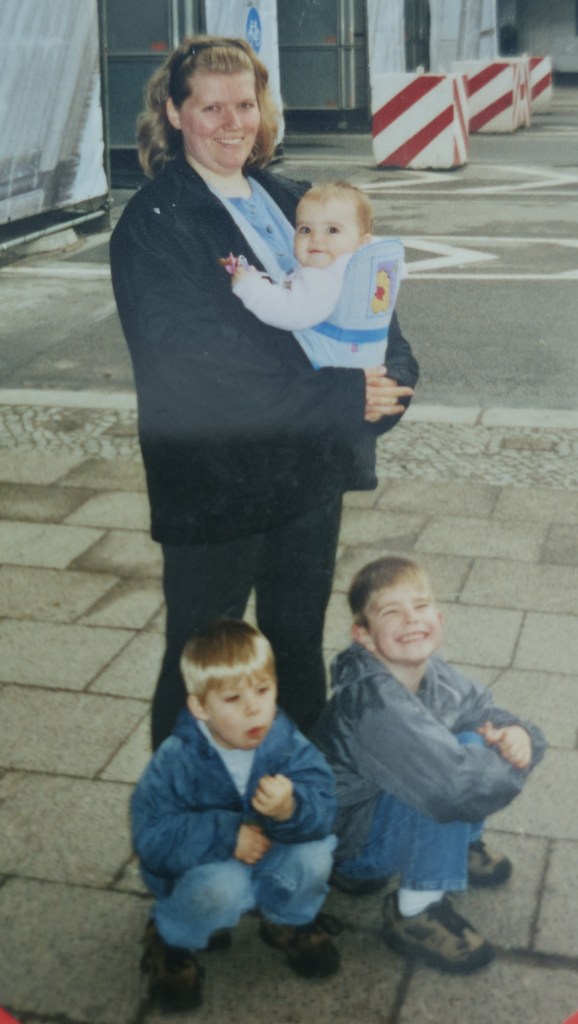
    Stephanie with our children during our family trip to Berlin in 2002.

    Our destination was Normandy. As a veteran, I was intent on experiencing the D-Day beaches, wanting to stand where the Greatest Generation cracked Hitler’s Atlantic Wall in 1944. We drove out of Germany, passed through Luxembourg City, and headed up into Belgium. Along the way, I spotted a cluster of old, concrete wartime pillboxes sitting silently near the tree line.

    Captivated by the history, I pulled the car over. Stephanie stayed back with our baby girl while I took both of my young boys, Robert and Jon, by the hand. We walked right out to those cold, moss-covered fortifications, exploring the old firing slits and touching the concrete together. I didn’t know the exact history of those specific bunkers at the time; I just wanted my boys to see a piece of the world their country had fought to free.
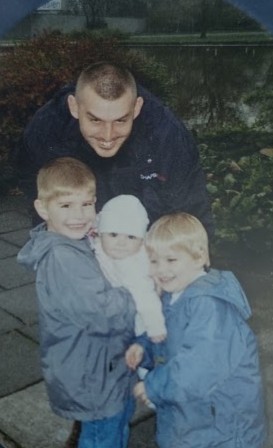
    Joseph Howell with his three children during a family visit to Berlin in 2002.

    After a few minutes, we saddled back up and continued our journey to the coast.

    The trip was incredible, but it was the drive back to Schweinfurt that secretly held the real magic.

    Leaving Paris, we took the A4 highway, the Autoroute de l’Est, heading eastbound back toward Germany. It was a peaceful, scenic drive. My family was safe, free, and buckled into the back seat. I was just focused on the road, completely unaware of the geography passing outside my window.

    I didn’t know it then. I wouldn’t find out until Stephanie cracked open the archives this year.

    As our tires rolled down the A4, we were traveling through the Argonne region. We passed Sainte-Menehould and continued toward Verdun, through countryside intimately connected with the battlefields of the First World War. Somewhere north of our route lay the ground over which American soldiers had fought against the heavily fortified German defensive system known as the Kriemhilde Stellung.

    And that is where the timeline folds in on itself.
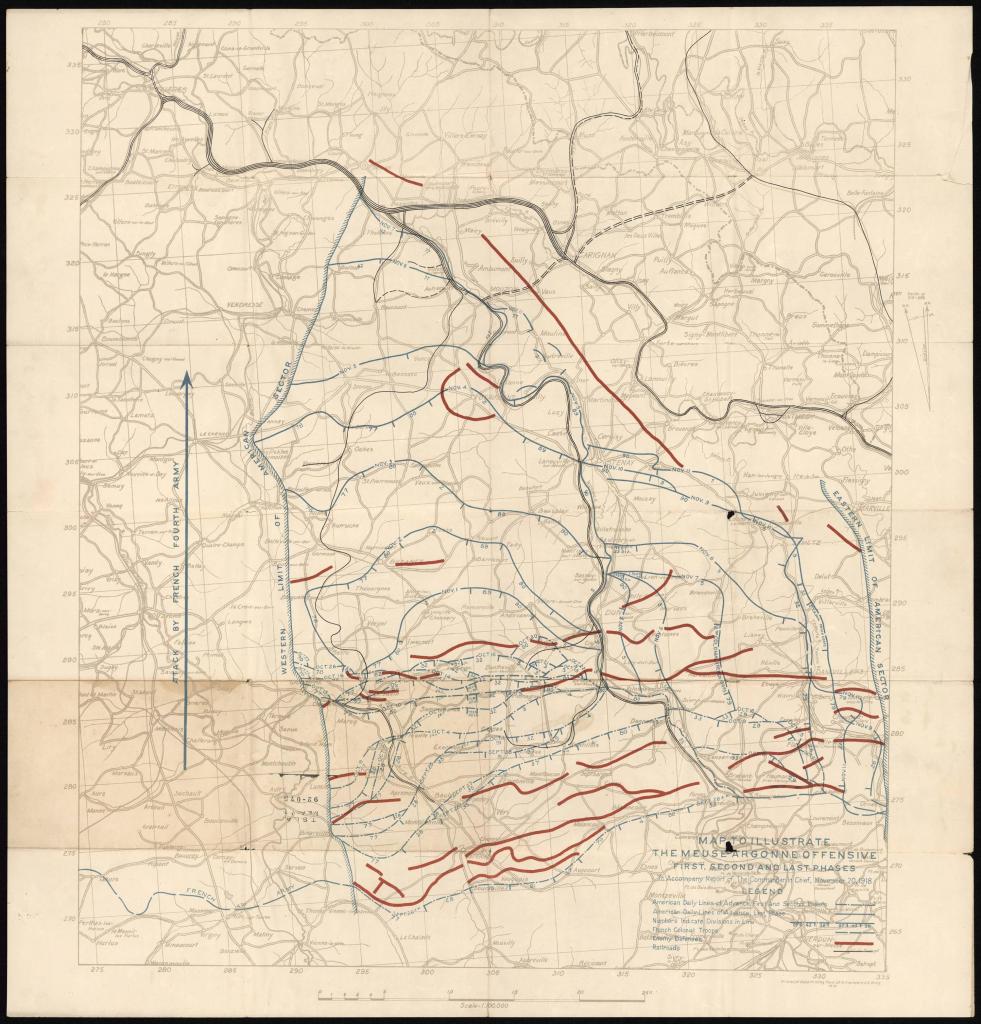
    Map of the Meuse-Argonne Offensive showing the American advance through northeastern France in 1918. Library of Congress.

    In October 1918, my grandfather—and my exact namesake—Joseph Robert Howell was serving in that campaign. He was an artilleryman with the 150th Field Artillery, part of the 42nd “Rainbow” Division, as American forces fought to break through the German defenses during the Meuse-Argonne Offensive.

    During that fighting, the 42nd Division moved into the line and relieved a battered division that had suffered heavily while fighting across those ridges.

    That unit was the 1st Infantry Division.
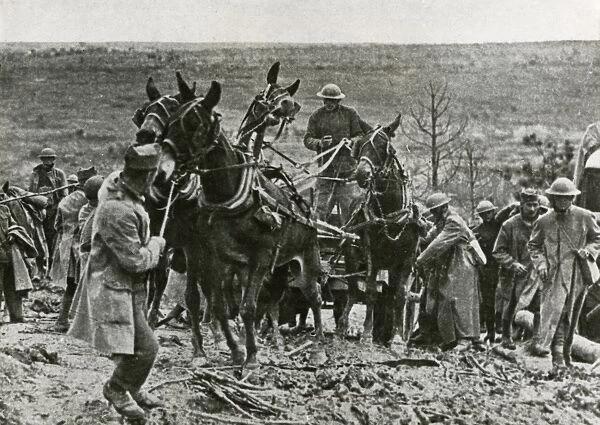
    Guns and horses of the 150th Field Artillery, 42nd “Rainbow” Division, waiting to move toward the front in France during World War I. Library of Congress.

    The Big Red One.

    My unit.

    During the final weeks of the war, my grandfather was severely wounded. He survived those wounds, came home, and passed his name down to me.

    Decades later, the Army sent me across the Atlantic to serve in the exact division his division had relieved, proudly walking in the lineage of the 4th U.S. Cavalry—the very regiment his brother George had served in back in 1911.

    But that is a story for another time, a masterclass in connecting the dots in genealogy.

    Driving down that highway in 2002, I missed the chance to consciously connect with him. I didn’t pull over. I didn’t know to look out the window and whisper a thank you. Realizing now just how close I had unknowingly come to the battlefield where he fought, I’ll admit it brings chills to my arms and tears to my eyes.

    But I didn’t miss the connection.

    Not really.

    Because Joseph Robert Howell was in the mud of France in 1918, enduring the artillery, gas, and misery of one of the final campaigns of the First World War, so that eighty-four years later, his grandson could drive his own children through those same valleys in absolute peace.

    And the ultimate victory? The proof that the warrior gene never left our bloodline?

    Years after that roadside stop, that same legacy of military service would quietly wake up in the next generation. One of those small boys who stood with me at those old concrete bunkers would grow up to put on the uniform himself, stepping forward to lead soldiers on the front lines today. The tradition endures, carrying the family’s quiet dedication to duty forward into a third century.

    We didn’t know it in 2002, but as we drove down the A4, the past, the present, and the future of our family were all riding in the exact same car.


    Historical Note: This story is part of a continuing series exploring the Howell family’s military legacy across generations. It is based on family records, military records, historical sources, and documented family research. Some narrative details are included to place those records within their historical setting. Where surviving records do not establish an exact location, event, or circumstance, the narrative should be understood as historical context rather than a statement of documented fact.

  • From Ranks to Records: How an Old Military Ledger Brought My Family History to Life

    From Ranks to Records: How an Old Military Ledger Brought My Family History to Life

    My husband is obsessed with genealogy. For years, he has researched his grandfather, Joseph Robert Howell, following him through records and piecing together the details of his life. He has also repeatedly tried to draw me into the project.

    I usually resisted.

    Names, dates, and isolated facts simply do not stick with me, and genealogy research often left me more frustrated than fascinated. But I do have one useful skill: I love old documents, and I am particularly good at reading vintage cursive handwriting—a beautiful art form that is slowly disappearing.

    Recently, my husband reached a difficult point while examining the World War I Morning Reports for Battery C of the 150th Field Artillery Regiment. Many of the pages were faded and handwritten, so he asked for my help deciphering them.

    I love a good challenge, and my competitive streak quickly took over. I wanted to be the first one to find something.

    The Mystery of the Missing Ranks

    Sitting down with the digital files, I tuned out everything around me and concentrated on finding one name: Joseph Howell.

    It did not take long to find my first clue.

    On October 2, 1917, a cramped handwritten entry recorded:

    1st cl Pvts Lovejoy, Messner, Howell, Freyman to Corporals vice vacancy.

    My husband, an Army veteran, immediately recognized the military shorthand. Joseph had been promoted from Private First Class to Corporal. The phrase “vice vacancy” was less familiar. Research showed that vice was used in military and administrative language to indicate that someone was serving in place of another person or filling a vacancy.

    We had found him. That was the goal, right?

    Not quite.

    My husband believed there had to be more. He encouraged me to continue through the reports, particularly looking for references to injuries, illness, or hospitalization.

    A few nights later, unable to sleep, I opened the records again. Only five days after Joseph’s promotion, an entry dated October 7, 1917, revealed an unexpected change:

    Corp Joseph Howell reduced to Pvt S.O. 25.

    Joseph had been reduced from Corporal to Private, leaving us with an obvious question: Why had he been promoted and then reduced in rank only five days later?

    The entry cited “S.O. 25,” referring to Special Order No. 25. The Morning Report recorded the action but did not explain the circumstances behind it. Finding that order—and discovering what happened—became another research question for another day.

    For the moment, we kept going.

    Joining the “Rainbow”

    As I worked through the daily reports, I began to see something beyond Joseph’s individual entries. The records were documenting the movements and transformation of an entire military organization.

    Near the end of October 1917, the reports recorded the unit’s movement from Long Island, New York, across the Atlantic and eventually to Camp de Coëtquidan, France.

    Research into the unit’s history gave those movements greater meaning. The 150th Field Artillery had originated as an Indiana National Guard organization before entering federal service during World War I. It became part of the 42nd Division, better known as the “Rainbow Division.”

    The division brought together National Guard units from states across the country. Its nickname has long been associated with Douglas MacArthur, then a young Army officer, and the idea that the division’s units stretched across the United States like a rainbow.

    Suddenly, the places and dates in the Morning Reports were no longer simply entries on a page. They were tracing Joseph’s movement from Indiana to New York and then overseas as part of the American war effort in France.

    On November 21, 1917, Joseph appeared again:

    1st cl Pvt Thomas J Cavanaugh and Private Joseph Howell from Pvts to Corporals R.S.O. 26 11/20/17.

    Joseph was a Corporal again.

    This time the entry cited “R.S.O. 26,” a Regimental Special Order dated November 20. Once again, the Morning Report documented the personnel action while pointing us toward another potentially valuable record.

    Mules, Machinery, and 155mm Howitzers

    By winter, I had begun to understand the structure of the Morning Reports themselves. What had initially looked like pages of nearly indecipherable handwriting and numbers had developed a pattern.

    The reports tracked the unit’s strength and status while also recording changes involving individual soldiers.

    Joseph appeared again during the winter:

    December 27, 1917: Corp Joseph Howell fr. D to SK in Hosp.

    He had gone from duty to sick in hospital.

    Then, on January 6, 1918:

    Corp Howell fr SK in Hosp to D.

    He had returned from the hospital to duty.

    As the unit continued its service in France, another part of the reports caught my attention: the accounting of horses and mules.

    The numbers were not incidental. Artillery units depended heavily upon animals for transportation. The 150th Field Artillery eventually operated French-designed 155mm Schneider howitzers, heavy artillery pieces that required substantial logistical support.

    The Morning Reports helped reveal that logistical side of the war. Horses and mules had to be maintained, replaced, fed, and cared for. Soldiers were needed to handle them and keep the battery functioning.

    What initially appeared to be mundane accounting began to tell another story. A field artillery regiment was not simply a collection of soldiers and guns. It was an enormous moving system of men, animals, equipment, ammunition, and supplies.

    By the summer of 1918, however, the tone of the records changed.

    More entries began recording soldiers who had been wounded or killed. The administrative language remained brief and unemotional, but the reality behind it was unmistakable.

    At one point I encountered another soldier named Howell who had been killed in action. He was a transfer and apparently unrelated to our family, but seeing the name stopped me for a moment.

    By then, these were no longer simply names in an old ledger.

    Wounded During the Meuse-Argonne Offensive

    During the autumn of 1918, the 42nd Division participated in the Meuse-Argonne Offensive, part of the massive final Allied operations of the war.

    Then came the entry we had been hoping—and perhaps dreading—to find.

    On October 18, 1918, Joseph’s name appeared again:

    Corp Joseph R. Howell 143910 slightly wounded in right arm. Hospital not known.

    Another entry provided an additional detail:

    Injuries caused by enemies’ bombs.

    For the first time, we had a contemporary military record documenting not only that Joseph had been wounded, but when he was wounded, where on his body he was injured, and what the Army recorded as the cause.

    The Morning Reports do not tell us precisely what happened on the battlefield or the exact circumstances in which Joseph received the wound. Those questions require additional records. But the brief entries establish something that family stories alone could not: Joseph was wounded while his unit was serving in France during the final weeks of World War I.

    He survived, but he subsequently disappeared from the battery’s active roster.

    On November 25, 1918, two weeks after the Armistice, Joseph’s name appeared among soldiers recorded as:

    dropped fr Rolls per GO 111, GHQAEF 1918.

    The notation referred to General Order No. 111 issued by General Headquarters, American Expeditionary Forces. Understanding exactly how that order applied to Joseph—and what happened to him after he left the battery’s rolls—opened yet another avenue of research.

    The Morning Reports had answered one question while creating several more.

    That, I was beginning to learn, is genealogy.

    Where History Meets the Heart

    Discovering the date and circumstances of Joseph’s wound changed the way I looked at these records.

    I could begin to picture the world behind the handwriting: France, the artillery batteries, the horses and mules, the hospitals, and the men whose names appeared for only a line or two before disappearing from the pages.

    I have never considered myself a military historian. If someone had told me a month earlier that I would spend nights studying century-old Army Morning Reports, I probably would have laughed.

    But somewhere along the way, Joseph Howell stopped being merely my husband’s grandfather.

    He became a young soldier whose movements I could follow through records created more than a century ago. I could watch him gain rank, lose it, regain it, become sick, return to duty, go into combat, suffer a wound, and eventually disappear from his unit’s rolls.

    The records did not tell us everything. In many ways, they created as many questions as they answered.

    But they brought him to life.

    That may be what finally made me understand why my husband loves genealogy so much.

    Our ancestors cannot sit across the table and tell us what happened to them. What remains are the traces they left behind—photographs, letters, government records, military reports, newspapers, and sometimes a nearly illegible line of cursive handwriting buried in a century-old ledger.

    If we take the time to read those records carefully, the names and dates begin to become something more.

    They become people.

    And sometimes, while searching for their stories, we discover a little more about our own.