If you look closely enough at an old family tree, you start to realize that history isn’t just a collection of random names and dates. It is a living blueprint. Sometimes, the choices made by people generations apart seem to follow strangely familiar roads.
That is one of the things genealogy has taught me.
We don’t always know why we’re drawn toward certain places, occupations, or ways of life. Sometimes we simply feel the pull. Then, years later, we open an old record and discover that someone generations before us walked a strangely familiar road.
Over the last two weeks, I shared how a family road trip through France collided with my grandfather Joseph’s footsteps in the mud of the Meuse-Argonne Offensive. I wrote about the spine-chilling moment I realized that decades later, the military had sent me to Germany to wear the same 4th Cavalry crossed sabers that his brother, my great-granduncle George, had worn during his service along the Mexican border.
But if we want to follow this family’s military story deeper into the past, we have to look beyond the trenches of World War I. We have to go back to a time before tanks, before gasoline pumps, and before the world had ever heard of a global war.
The next trail leads to their uncle—my great-great-granduncle, Tilghman Andrew Howell—an eighteen-year-old kid from Indiana who marched into the smoke of the Civil War, only to find himself in his own mother’s homeland.
And even Tilghman isn’t where this story begins. As the records will eventually show, the tradition reaches much farther back—through Howell men and through men who married into the Howell family.
Born to the Blue Ridge Lineage
Tilghman was born on August 7, 1845, in the familiar crossroads of Hartford City, Indiana. He was the second of eight children born to George Sumpter Howell and a woman whose maiden name rewrote our entire family geography: Amelia R. Rousseau.
Growing up in East-Central Indiana, Tilghman was surrounded by his mother’s Rousseau family connections. Amelia’s roots reached back to Wilkes County, North Carolina, and those ties were far more than names on a family tree. Her father, David Rousseau, remained close to Amelia and eventually died in northern Indiana. The Rousseau family line didn’t belong only to the flat cornfields of the Midwest; its roots ran deep into the rugged Blue Ridge foothills of North Carolina.
Those family ties would become even more significant later in Tilghman’s life. About twenty years after the Civil War carried him into North Carolina, he returned there and married his first cousin—the daughter of Amelia’s own sister.
But first, there was a war.
Tilghman was just a teenager when the Union fractured in 1861. For nearly three years, the Civil War raged while he grew from a fifteen-year-old boy into a young man.
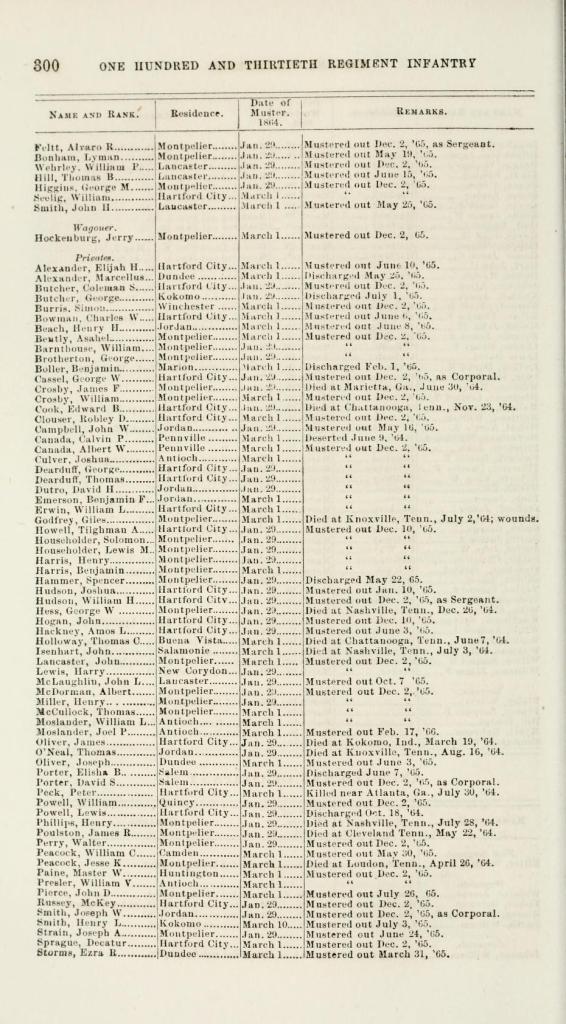
Then, on January 29, 1864, at just eighteen years old, he stepped forward. He signed his name, took the oath, and entered the Union Army as a Private in Company I, 130th Indiana Infantry.
Through the Fire of Georgia and Tennessee
Private Tilghman Howell didn’t get the luxury of a slow introduction to soldiering. The 130th Indiana was mustered into federal service in March 1864 and soon joined the XXIII Corps of the Army of the Ohio as Sherman’s armies prepared to move south into Georgia.
Tilghman spent his nineteenth birthday in the midst of the Atlanta Campaign.
With Company I, he served through the fighting at Resaca, the operations around Kennesaw Mountain, and the long campaign around Atlanta. The 130th continued through the operations at Utoy Creek, Jonesboro, and Lovejoy’s Station before the Atlanta Campaign finally came to an end.
When Atlanta fell, Tilghman’s unit eventually turned back north as Confederate General John Bell Hood carried the war into Tennessee.
Throughout the bitter winter campaign of 1864, Tilghman served with the 130th at the massive clashes of Franklin and Nashville, followed by the pursuit of Hood’s defeated Army of Tennessee toward the Tennessee River.
Through those campaigns, Tilghman remained with his company. He was never wounded, hospitalized, or detached from the unit. He had survived some of the hardest campaigning of the western war.
But it was the final movement of the war that turned his military service into an unbelievable full circle.
The Homeland Call
In early 1865, the 130th Indiana was moved by boat and rail for one final campaign against the remaining Confederate resistance.
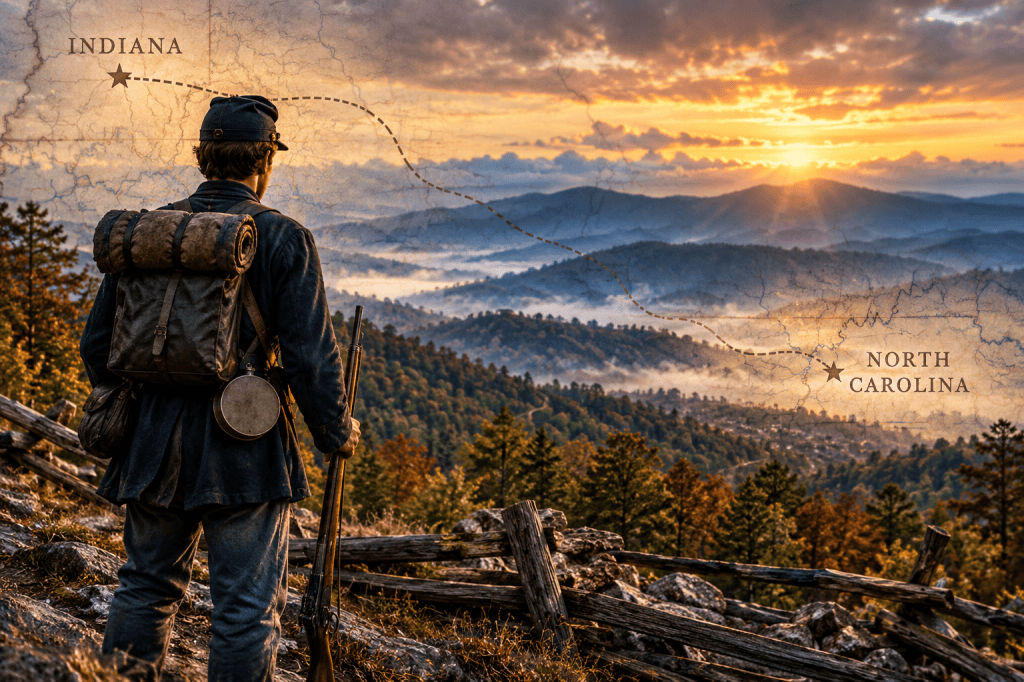
Their orders sent them across the map, straight into North Carolina.
For a nineteen-year-old Indiana kid, entering North Carolina meant that the war had carried him onto the native soil of his mother’s Rousseau family.
Tilghman moved with the 130th through the North Carolina campaign, including the operations around Kinston and Goldsboro, before the regiment advanced on Raleigh in April.
Then, on April 26, 1865, the campaign reached its conclusion at Bennett Place, where Confederate General Joseph E. Johnston surrendered his army to Union General William T. Sherman.
Tilghman had entered the Army as an eighteen-year-old Indiana private.
Now, at nineteen, he was standing in his mother’s home state as one of the last great Confederate armies surrendered.
But the Army didn’t send him home immediately.
The 130th remained in North Carolina after the fighting ended, performing occupation duty for the remainder of 1865. My archival research pulled up Tilghman’s official muster-out record: December 10, 1865.
He had spent much of the final year of his military service in North Carolina.
What that experience meant to Tilghman personally, no surviving military record can tell us.
But genealogy sometimes gives us another way of seeing the story.
The connection between Tilghman and North Carolina didn’t end when he took off the blue coat. About twenty years later, he returned. There, he married his first cousin—the daughter of Amelia’s sister—and ultimately made his home in Wilkesboro, North Carolina, on the ancestral ground of his mother’s Rousseau family.
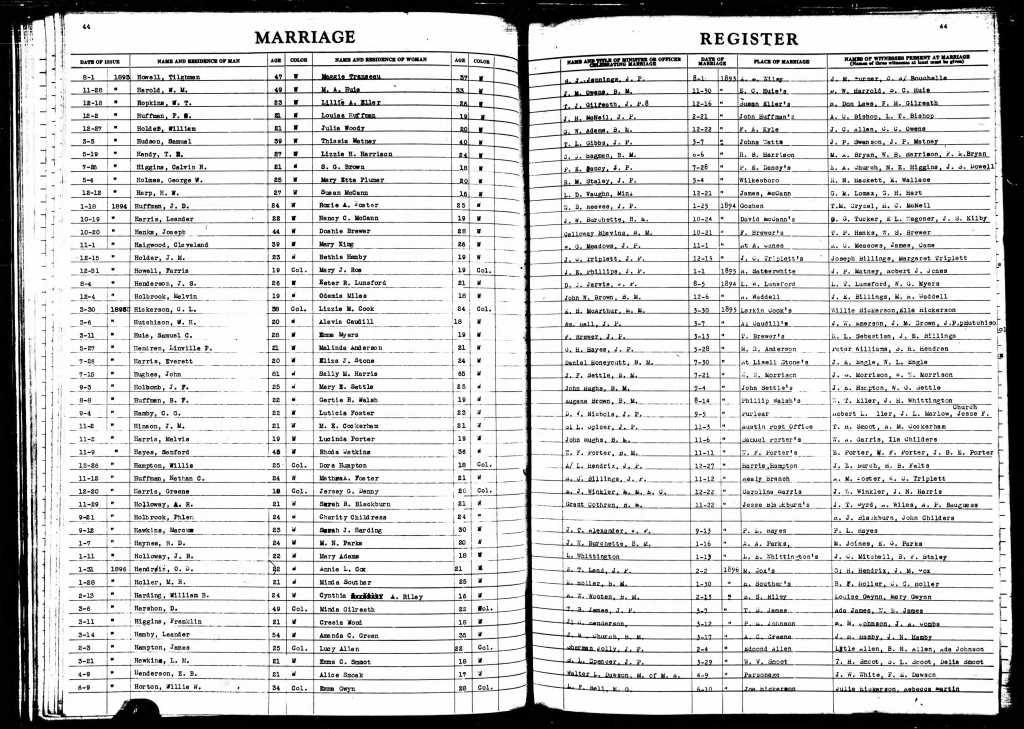
We cannot know exactly what pulled him back.
We only know that he went.
The Civil War had carried an Indiana boy into his mother’s homeland.
Decades later, the road pulled him back.
An Unbroken Creed
Tilghman lived to be 85 years old, passing away in those North Carolina hills on November 17, 1930.
Because of his long life, the generations overlapped in a remarkable way. While the aging Civil War veteran was living in North Carolina, his grandnephews George and Joseph had already written their own chapters of the family’s military history.
The surviving records may never tell us how much they knew about one another’s military service.
But genealogy lets us see something they may never have been able to see themselves.
The pattern.
Tilghman served during the Civil War. George and Joseph served in the generation that followed. My father later chose military service. I eventually put on the uniform myself. And today, one of those little boys who traveled through Europe with me has grown up to make that same choice, putting on the uniform to lead soldiers of his own.
Different generations. Different wars. Different lives.
But the thread keeps appearing.
And as I work backward through the records, I keep discovering that Tilghman wasn’t the beginning either.
The trail continues deeper into the family tree, through Howell men and through men who married Howell women—men whose service reaches into earlier American wars and, eventually, back to the Revolution.
Maybe that is one of the greatest gifts genealogy gives us.
We spend our lives making choices without always understanding why certain things appeal to us. We choose occupations. We move across the country. We wander. We serve. Sometimes we leave home, and sometimes, years later, the road pulls us back.
I’ve seen that pattern in my own life.
I’ve been drawn to things and only later discovered them buried in my family history. I’ve watched the Howells move from place to place across generations. Sometimes they stayed somewhere for years. Sometimes they put down deep roots. But sooner or later, somebody seemed to feel that pull of the road again.
Genealogy doesn’t necessarily tell me why.
It tells me that the pattern was already there.
Tilghman’s 1864 military record gives us the raw facts of a Civil War private. The rest of his records reveal something larger: an Indiana boy went to war, survived some of the hardest campaigns of the western theater, followed the Army into his mother’s North Carolina homeland, and decades later returned there to build the rest of his life.
Was that pull family connection? Memory? Circumstance? Something deeper? Or simply chance?
The records cannot answer that.
But after seeing the same kinds of patterns surface again and again in my own family, I have learned not to dismiss the pull simply because I cannot explain it.
Sometimes genealogy doesn’t tell us why we chose the road.
It shows us that someone in our family walked it before us.
Historical Note: This story is part of a continuing series exploring the Howell family’s military legacy across generations. It is based on family records, military records, historical sources, and documented family research. Some narrative details are included to place those records within their historical setting. Where surviving records do not establish an exact location, event, or circumstance, the narrative should be understood as historical context rather than a statement of documented fact.