
An investigation into a War of 1812 widow, the loss of family support, a mysterious family Bible, and a pension interrupted during the Civil War.
A Widow’s Story Hidden in the Records
In the mountains of southwestern Virginia, a woman named Nancy Ann Howell Rigney spent much of her life living with the consequences of a war that had ended decades earlier.
Her husband, Isham Rigney, served in the Virginia militia during the War of 1812. He died while in military service, leaving Nancy to face the responsibility of raising their children without him.
Years later, Nancy would lose one of those children as well.
As she grew older, her circumstances became increasingly difficult. She moved away from the Floyd County community where she had family connections and into Carroll County, where the support of nearby relatives was no longer as readily available.
By 1854, official testimony described her as extremely poor.
Then the Civil War brought another challenge. Nancy’s federal widow’s pension remained unpaid, and after the conflict she had to prove her loyalty to the United States to seek its restoration.
Yet Nancy’s story is not simply about two wars.
It is also about a family Bible, her father’s handwriting, conflicting dates, missing census records, and family relationships that remain unresolved.
What began as research into a distant Howell relative has become an ongoing investigation into the life of a woman who endured extraordinary uncertainty.
The Howell Family of Virginia
Nancy Ann Howell was born on October 26, 1791, in Montgomery County, Virginia, according to the family information assembled during this research.
She was the daughter of David Howell and a granddaughter of Joshua Howell, my fourth great-grandfather.
Nancy’s father, David, provides the direct connection between her story and my Howell family research.
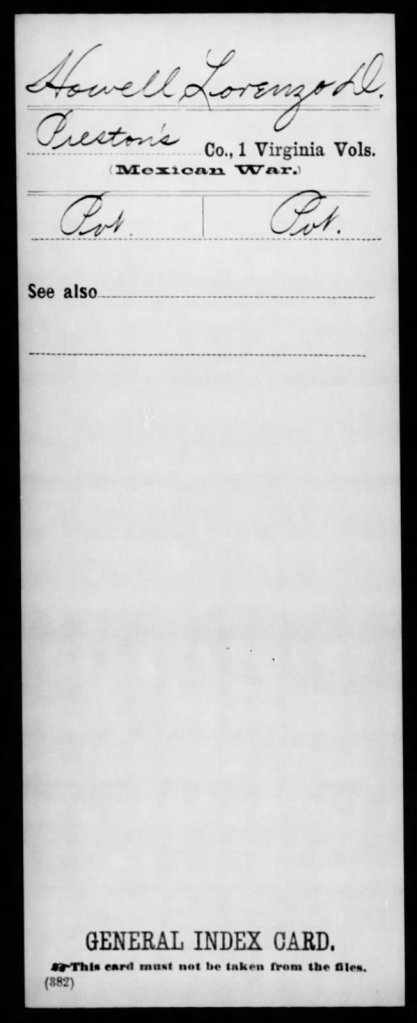
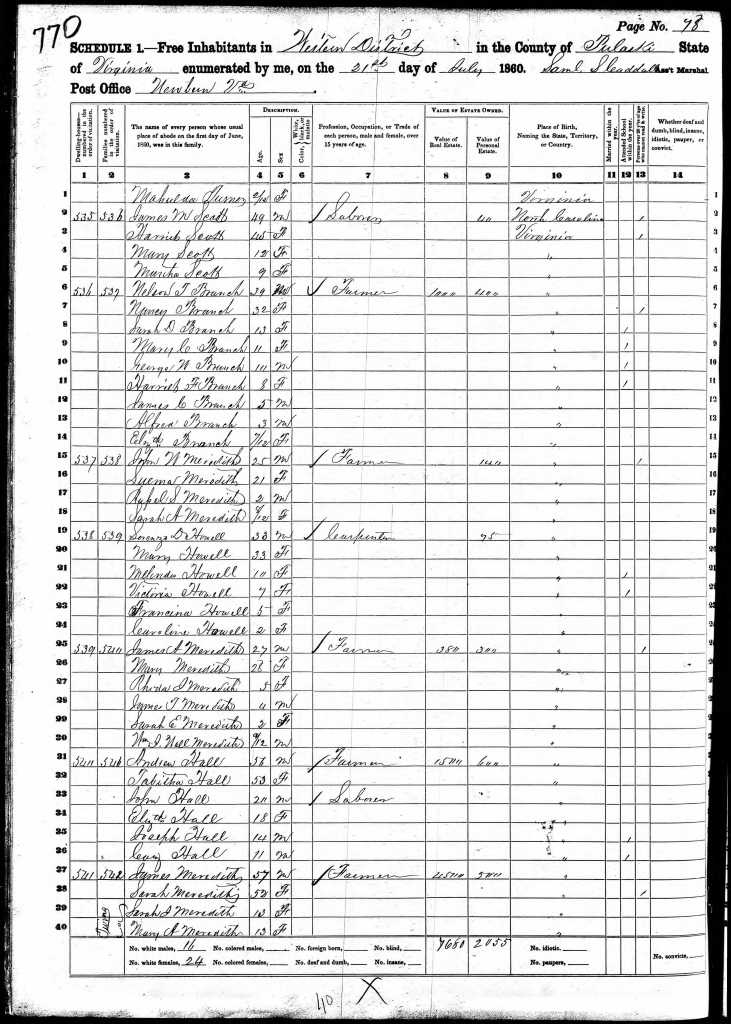
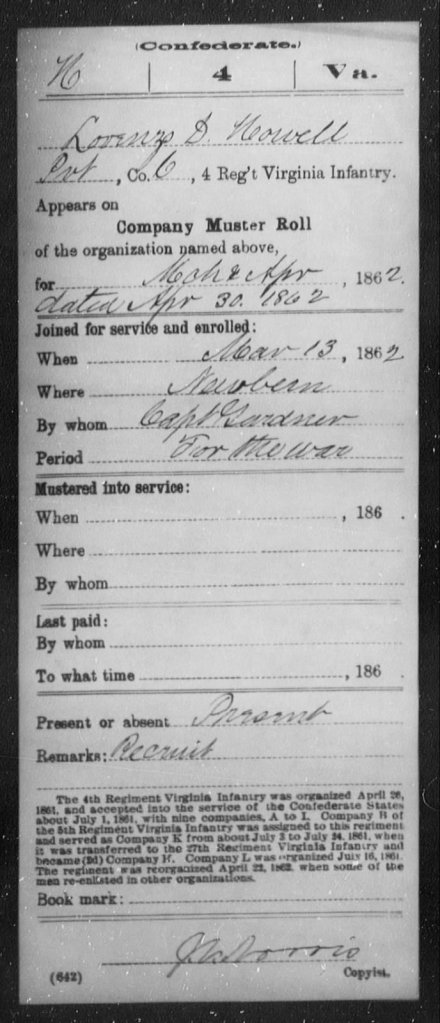
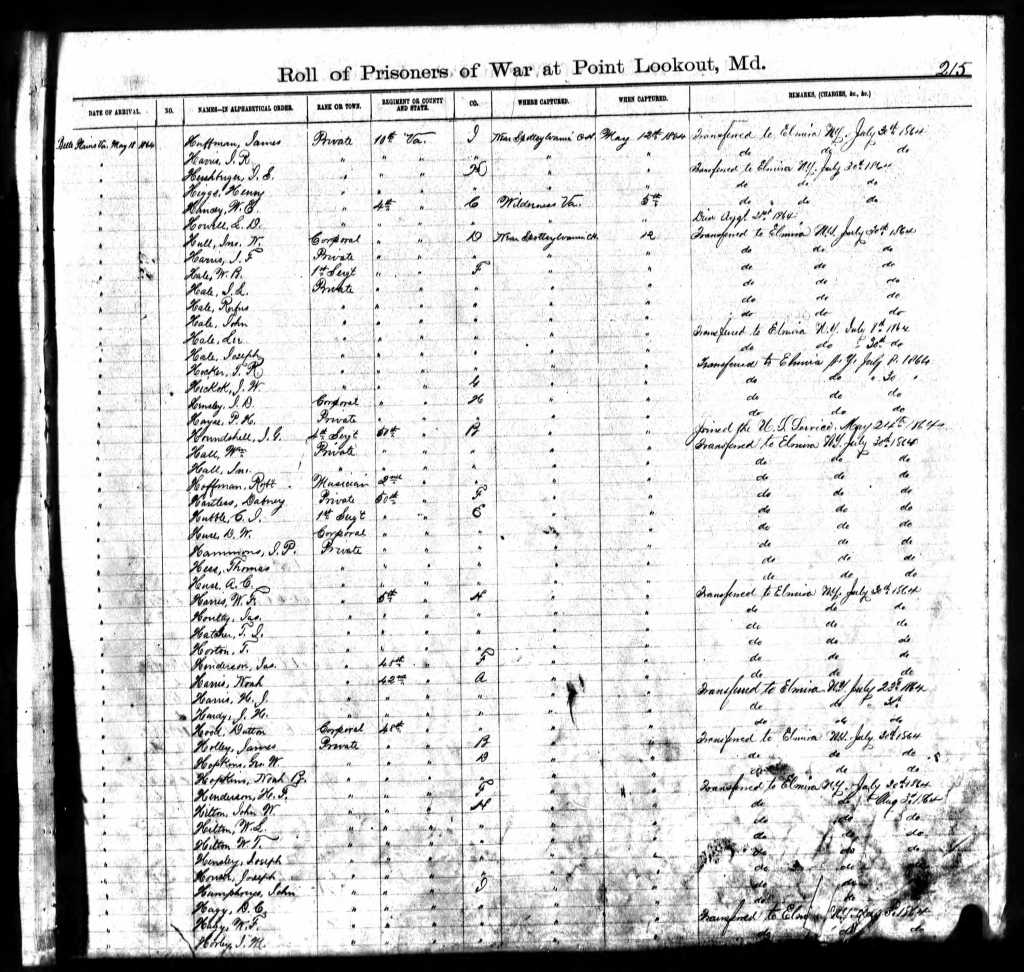
Her brother, Isaac Howell, was the father of Dillard Charles Howell and Lorenzo Dow Howell, two Civil War soldiers whose experiences I have previously researched.
This places Nancy within a family whose members were affected by two generations of American military conflict.
Isham Rigney served during the War of 1812. Decades later, Nancy’s nephews would experience the Civil War.
Nancy, however, was neither a soldier nor simply a name attached to a veteran’s pension application.
She was a daughter, sister, wife, mother, and widow whose life connected these generations.
Her story also demonstrates how important extended family relationships could be to a widow attempting to survive in nineteenth-century Virginia.
Marriage, Children, and the War of 1812
On December 22, 1808, Nancy Howell married Isham Rigney.
Isham, believed to have been born around 1790, served as a private in Captain James Hoge’s Company of the Virginia Militia during the War of 1812.
The couple had three children identified in the family research and pension evidence.
Their eldest was Jincy Rigney, also appearing as Jency or possibly Jane, reportedly born September 11, 1809. She later married Andrew Harris and is associated with four children: Ishmael, Joseph, Hiley, and Asa Harris.
Their second child, Andrew Rigney, was born October 2 or 3, 1811, and died November 8, 1882.
Their youngest, David Rigney, was born October 11, 1813.
David’s life would end in 1854, when he was approximately forty years old.
That death is an important part of Nancy’s story.
By the middle of the nineteenth century, she had already lived for decades without her husband. Now she had also outlived her youngest son.
We do not yet know the circumstances of David’s death or precisely how it affected Nancy’s household. But it is another loss that must be considered when reconstructing the family relationships and support available to her.
There is also a significant disagreement concerning Isham’s death.
Some family-tree information gives January 14, 1815, in Norfolk, Virginia.
An official Treasury Department report dated April 1, 1854, however, states that Isham died in service on January 14, 1813.
If the Treasury date is correct, Nancy was pregnant with David when Isham died, making David a posthumous child.
If the 1815 date is correct, David was already more than a year old.
The difference changes our understanding of Nancy’s earliest years as a widow.
For now, the conflicting dates remain an active research question rather than a settled conclusion.
A Family Bible and David Howell’s Handwriting
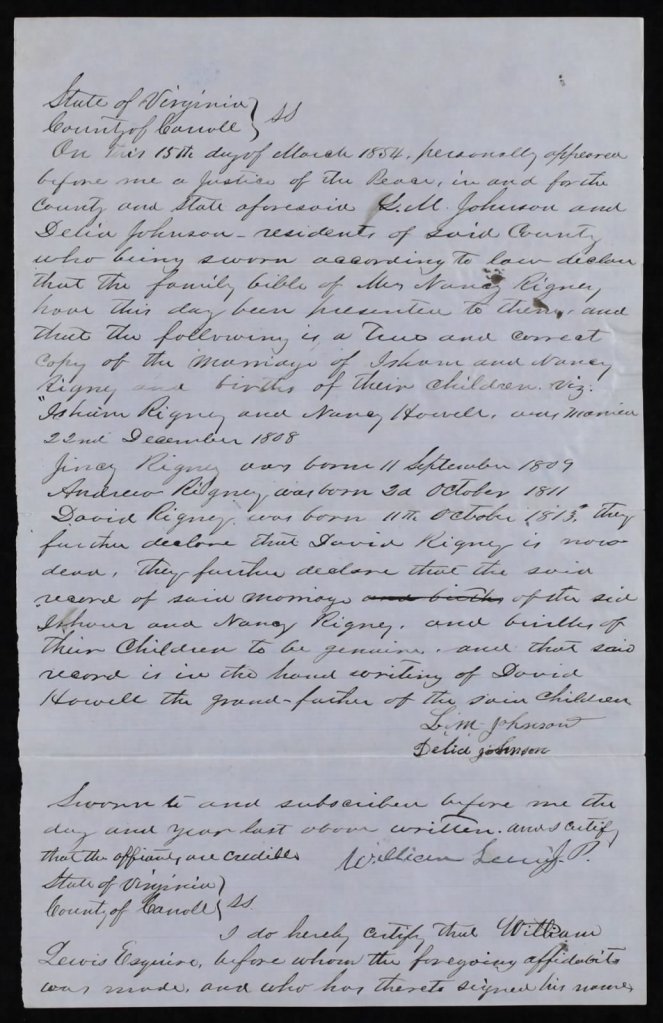
One of the most valuable discoveries in Nancy’s pension papers is an affidavit dated March 15, 1854.
Two witnesses, L.M. Johnson and Delia Johnson, testified about entries in a family Bible belonging to Nancy Rigney.
The entries concerned Nancy’s marriage and the births of her children.
The witnesses attributed the handwriting to David Howell, grandfather of the Rigney children.
David Howell was Nancy’s father.
This creates a particularly meaningful connection to the earlier Howell generation.
The affidavit suggests that David personally recorded important events in his daughter’s family.
For genealogists, family Bible records can be valuable because they may preserve information recorded close to the time an event occurred.
But the distinction between original evidence and later testimony is essential.
The surviving affidavit was signed by the Johnsons, not by David Howell. They testified that the entries they examined were in his handwriting.
The original Bible pages have not yet been located.
This leaves several questions.
Where did the Bible go after Nancy’s death? Did it remain with one of her children or grandchildren? Were any original pages ever submitted with the pension application?
And could the original handwriting resolve a problem with the eldest child’s name?
The affidavit appears to transcribe that name as James, while other family evidence identifies a daughter, Jincy or Jane, who married Andrew Harris.
I have not yet resolved that discrepancy.
A marriage document involving Andrew Harris, reportedly bearing the signature of Beaufort Howell, may provide another connection to the extended Howell family once it is located and examined.
The Bible affidavit is therefore both a discovery and an invitation to continue searching.
From Floyd County to Carroll County: Losing Family Support
Another important part of Nancy’s story involves her move from Floyd County to Carroll County, Virginia.
The Howell family had connections in the Floyd County area, where relatives could potentially provide assistance, companionship, and practical support.
For a widow raising children, such relationships could make an enormous difference.
Family members might share food, provide temporary shelter, help with farming or household responsibilities, or assist during illness.
Nancy’s move to Carroll County placed her farther from the familiar family network she had known.
That change deserves attention because it may have reduced the support available to her during her later years.
The precise date and circumstances of the move remain to be established, as does the extent of assistance she received from relatives before and afterward.
We should also be careful not to confuse a change of county name with a physical move. Floyd County was created from Montgomery County in 1831, while Carroll County was established from Grayson County in 1842. County boundaries and record jurisdictions must be considered when tracing Nancy’s residences.
Nevertheless, the family circumstances raise an important question: How much did Nancy’s move affect her ability to survive financially?
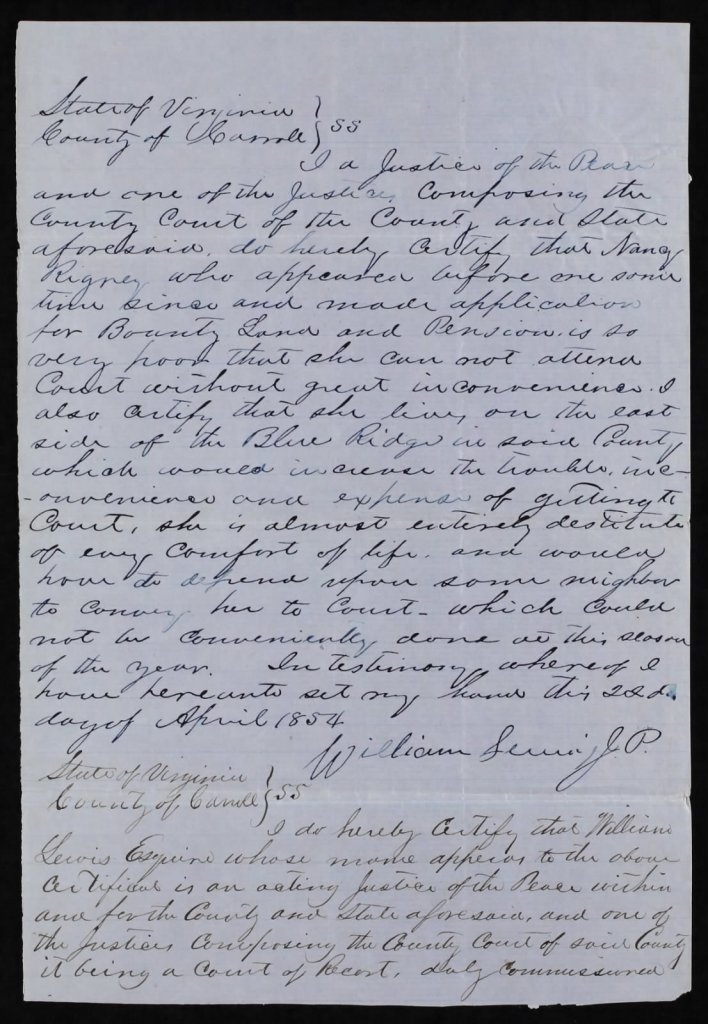
By 1854, the documentary evidence reveals a woman in severe poverty.
On April 22 of that year, Justice of the Peace William Lewis provided a statement explaining that Nancy lived on the eastern side of the Blue Ridge Mountains and could not afford to travel to court.
His statement described her as extremely poor.
Here was a woman who had lost her husband decades earlier, whose youngest son died during that same year, and whose access to her extended Howell family network had changed.
The surviving documents do not prove that David Rigney’s death or the move caused her poverty.
They do, however, show why those events deserve investigation alongside her financial circumstances.
Nancy’s story was shaped not only by military service and pension legislation, but also by the people who were—or were no longer—close enough to help her.
The Pension That Helped Her Survive
Nancy’s pension records provide a glimpse into her financial life.
An April 1, 1854 report from the Treasury Department’s Third Auditor identifies an earlier widow’s half-pay pension of four dollars per month, associated with Isham’s military service.
A later certificate, dated June 27, 1860, recognized an entitlement of four dollars per month beginning February 3, 1858.
The various dates and administrative actions suggest that Nancy’s pension history was not straightforward.
Different pension laws, applications, and reviews appear to have affected her claim over time.
For a woman described as extremely poor, four dollars per month represented meaningful assistance.
The pension was not simply recognition of Isham’s service.
It was a source of financial support that Nancy had reason to pursue and protect.
But even that support would become uncertain.
The Civil War Reaches Nancy’s Household
When the Civil War began in 1861, Nancy was approaching seventy years of age.
Her husband’s military service belonged to a war fought nearly half a century earlier.
Yet the new conflict would affect her pension.
A Treasury Department letter dated July 17, 1867, reported that Nancy’s last pension payment had been made on September 4, 1860.
That date is important because it predates the beginning of the Civil War.
We cannot simply assume that her payments stopped on the day hostilities began. The surviving documents require a more careful reconstruction of when payments ceased and why.
What is clear is that Nancy’s pension remained unpaid during the Civil War period and that she later pursued its restoration.
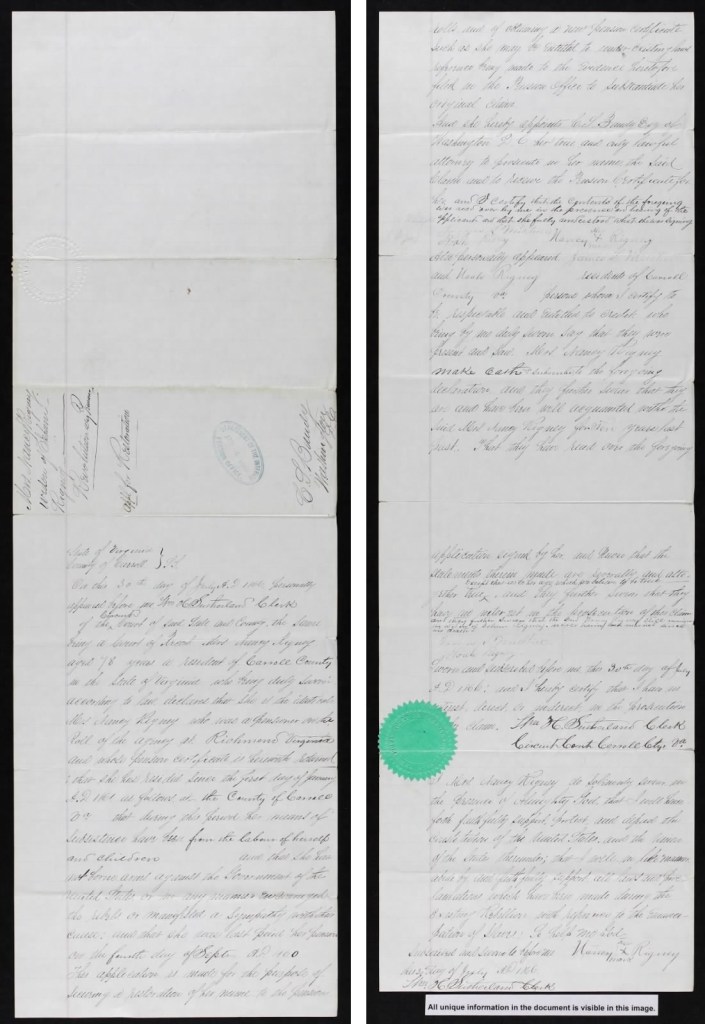
On July 30, 1866, she submitted an affidavit in Carroll County declaring that she had remained loyal to the United States and had not aided the Confederacy.
Supporting witnesses also testified.
Consider the circumstances.
Nancy had been widowed by the death of a soldier who served the United States during the War of 1812.
She had spent decades raising her family and struggling financially.
Now, after another war, she was required to establish her loyalty to the same federal government from which she sought her widow’s pension.
The pension file includes correspondence about the effort to restore her benefits.
A certificate dated July 24, 1867, authorized four dollars per month beginning September 4, 1860.
That date establishes an administrative entitlement, but it does not necessarily mean Nancy had actually received payments throughout the intervening years.
The surviving correspondence suggests continuing complications.
Whether all money owed to Nancy was eventually paid remains an important question.
When Official Records Disagree
One of the most interesting lessons from Nancy’s research is that even government records can contradict one another.
The disagreement over Isham’s death date is one example.
Another appears in later pension correspondence, where Isham is sometimes described as a Revolutionary War soldier.
That identification is inconsistent with the evidence placing his service in the War of 1812.
Given his approximate birth around 1790, service during the Revolutionary War would not be chronologically possible.
The reference may reflect a clerical mistake or confusion involving pension classifications.
These inconsistencies are not reasons to abandon the documents.
They are reasons to examine them more closely.
A genealogist must distinguish between what a record says, what the record actually proves, and what remains uncertain.
The same principle applies to family trees.
An unsourced date or relationship repeated across multiple online trees does not become reliable merely through repetition.
Nancy’s story requires us to return repeatedly to the original evidence.
The Questions Still Waiting for Answers
Despite the remarkable information preserved in her pension papers, much of Nancy’s life remains unresolved.
I still want to establish the correct date and location of Isham Rigney’s death.
I want to determine when Nancy moved from Floyd County to Carroll County and whether land, tax, court, or census records can reveal more about her living arrangements.
The death of David Rigney in 1854 also deserves further investigation. Where was he living? Did he leave a wife or children? Was he helping support Nancy? Did his death alter her circumstances?
We know his death belongs in the family chronology, but we do not yet know the full story behind it.
I also want to identify the original Bible entries attributed to David Howell and resolve the conflicting reading of Nancy’s eldest child’s name.
Additional questions concern Nancy’s missing census appearances, allegations of a later marriage, and the identities or parentage of Leander and Jehue H., whose possible relationships remain uncertain.
These questions cannot be answered responsibly by assigning people to families simply because their names appear together in an online tree.
Each connection requires evidence.
The pension papers have already revealed far more than a widow’s name and a soldier’s military service.
There may still be discoveries waiting in county records, pension correspondence, family collections, and surviving documents that have not yet been connected to Nancy.
Nancy’s Final Years
According to the family information gathered during this investigation, Nancy Ann Howell Rigney died on February 15, 1868, in Carroll County, Virginia.
She was approximately seventy-six years old.
Her life had spanned the early American republic, the War of 1812, the growth of southwestern Virginia communities, the Civil War, and the beginning of Reconstruction.
During those decades, she experienced the death of her husband and later the death of her son David.
She also faced changes in her family support network, financial hardship, and repeated administrative struggles over her widow’s pension.
The records do not tell us everything about her personality, beliefs, or private feelings.
They do, however, reveal a woman who continued pursuing the benefits connected to her husband’s service despite age, poverty, and the upheaval of another war.
The Investigation Continues
I began researching Nancy Ann Howell Rigney because she was connected to my Howell ancestors.
I expected to find a marriage, a few children, and perhaps a military pension.
Instead, I found a much more complicated story.
Her father’s handwriting appeared indirectly in a family Bible affidavit.
An official Treasury document challenged the death date repeated in family research.
A justice of the peace described her inability to afford a trip to court.
Her youngest son’s death in 1854 raised questions about another loss during an already difficult period.
Her move from Floyd County to Carroll County opened a new line of inquiry into the extended family support she may have left behind.
And her postwar pension application revealed an elderly widow required to prove her loyalty to the United States.
Each discovery has brought Nancy’s life into sharper focus.
Each has also produced new questions.
I still do not know everything about the woman who was Nancy Ann Howell Rigney.
But I know far more about her than I did when this investigation began.
And perhaps that is the most important lesson her story offers.
Genealogy is rarely a straight line from one answer to the next.
Sometimes a document settles a question. Sometimes it challenges what we thought we knew. And sometimes the most revealing discovery is a new mystery that sends us searching again.
Nancy Ann Howell Rigney’s story is not finished.
Neither is the research.
Nomadic Roots Research — Following family stories wherever the records lead.
Research note: This article draws primarily on Nancy Rigney’s surviving pension papers, including the March 1854 family Bible affidavit, April 1854 Treasury correspondence, Justice William Lewis’s statement concerning her poverty, pension certificates, and the 1866 loyalty affidavit. Family information concerning David Rigney’s death and Nancy’s relocation requires further verification to establish its full chronology and significance.