
From the mountains of Virginia to Mexico, the Wilderness, and a prison camp in Maryland—the story of a carpenter, husband, father, and soldier whose life crossed two defining American conflicts.
History remembers generals, presidents, and famous battles. Yet behind those familiar names were ordinary people whose lives became entangled with events far larger than themselves. Lorenzo Dow Howell was one of them.
Born around 1826 in southwestern Virginia, Lorenzo served the United States during the Mexican-American War. He returned home, married, worked as a carpenter, and raised a family. Then the nation divided. In 1862, he entered Confederate service with the 4th Virginia Infantry. His records tell of illness, interrupted service, capture at the Wilderness, and death as a prisoner of war at Point Lookout, Maryland, on August 21, 1864.
His story begins, however, in the mountains of Virginia—and ends with a family connection that leads to another remarkable story.
Roots in the Virginia Mountains
Lorenzo Dow Howell was born around 1826 in the region associated with Montgomery and Floyd counties, Virginia. Family research identifies his parents as Isaac Howell (1807–1880) and Catharine Thomas (1810–1850).
Lorenzo was one of five children born to Isaac and Catharine. After Catharine’s death, Isaac married again and had seven additional children. Across two marriages, Isaac fathered twelve children: Lorenzo, his four full siblings, and seven half-siblings. The family’s children were born over approximately forty years. Some of Lorenzo’s youngest half-siblings were born after his death.
These relationships place Lorenzo within a large, extended Virginia family. They also provide an important connection to his younger brother Dillard Charles Howell, whose wartime experience would eventually lead him to the same prison camp.
The First War: Mexico
War broke out between the United States and Mexico in 1846 amid disputes over Texas, the international boundary, and American expansion. Volunteer companies formed across the United States, including in Virginia.
James Francis Preston of Montgomery County organized a company known as the Montgomery Grenadiers, associated with the 1st Virginia Volunteers. Historical accounts describe Preston as helping to organize and equip the men at his own expense.
Among the soldiers identified in Preston’s company was Lorenzo Dow Howell.
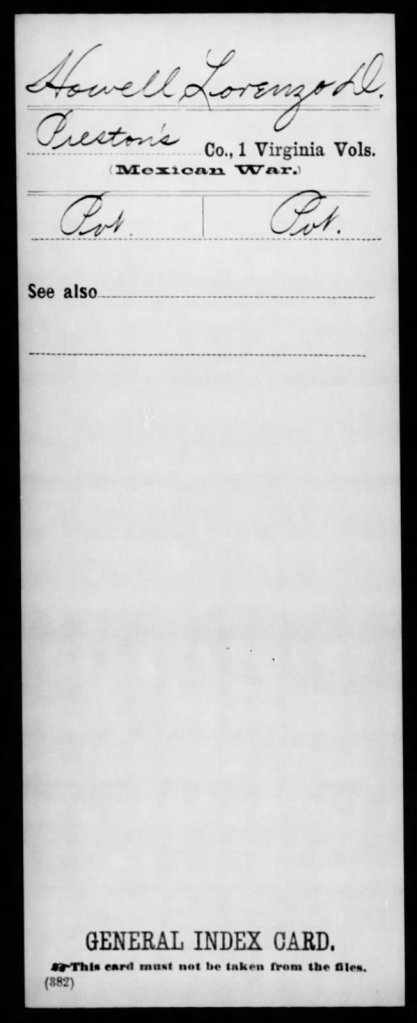
The card identifies Lorenzo as a private in Preston’s Company, 1st Virginia Volunteers. It establishes his unit and rank, although it does not give his individual enlistment dates or movements.
The Montgomery Grenadiers in Mexico
Preston’s company served in Mexico during 1847 and 1848. Historical accounts place the unit in northern Mexico, including the areas of Monterrey and Buena Vista. The Battle of Buena Vista occurred in February 1847, before the company reportedly arrived that April. Its documented duties are therefore better described as garrison and defensive service, not participation in that battle.
Even away from major fighting, military service could be dangerous. Disease, exposure, shortages, and camp conditions threatened soldiers far from home. One account reports that twelve members of the Montgomery Grenadiers died of disease. That is a detail about the company, not evidence of Lorenzo’s personal medical history.
The war ended in 1848 with the Treaty of Guadalupe Hidalgo. The United States acquired extensive western territories, intensifying disputes over whether slavery would expand into those lands. Those disagreements helped set the stage for the next conflict in Lorenzo’s lifetime.
For the moment, he returned to civilian life in Virginia.
Marriage, Children, and Civilian Life
On February 8, 1849, Lorenzo married Mary McDonald in Montgomery County, Virginia. He was approximately twenty-two or twenty-three years old.
Records connect the couple to a growing family. The 1860 federal census lists Lorenzo, age thirty-three, and Mary, also thirty-three, in the Western District of Pulaski County, Virginia, with the Newbern post office. Four younger household members appear with them: Melinda, age ten; Victoria, seven; Francina, five; and Caroline, two. Francina was also known as Fannie. Other family information identifies William Gordon Howell as a child of Lorenzo and Mary.
The census identifies Lorenzo’s occupation as carpenter. A Virginia birth-register entry associated with Victoria likewise identifies her father’s trade as carpentry; his surname appears in one index as Hawell.
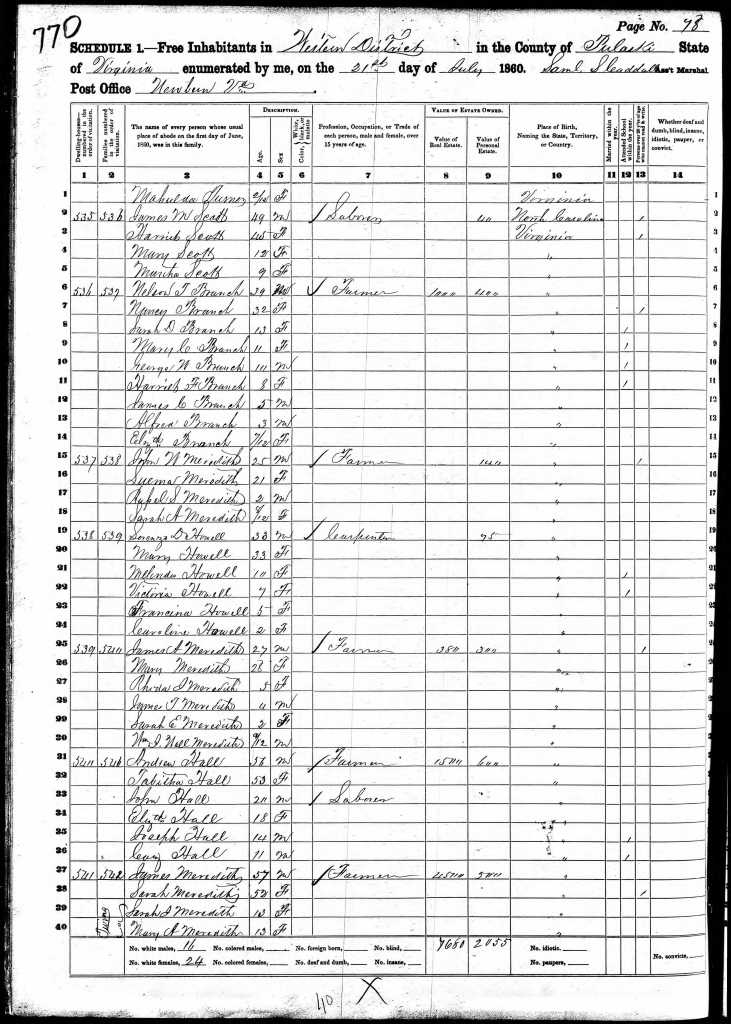
Carpentry was a practical and valuable trade in nineteenth-century Virginia. The record gives Lorenzo an identity beyond his military service: a working husband and father living in a community where houses, barns, and businesses depended on skilled hands.
For more than a decade after the Mexican-American War, Lorenzo’s life centered on family and work. Meanwhile, political divisions across the country were becoming harder to contain.
A Nation Moving Toward War
The 1850s brought escalating conflict over slavery and its expansion. The Compromise of 1850, the Kansas-Nebraska Act, and violence in Kansas revealed the depth of the sectional crisis. Following Abraham Lincoln’s election in 1860, southern states began leaving the Union. Virginia seceded in 1861.
The contrast in Lorenzo’s military record is striking. He had served as a United States volunteer in the Mexican-American War. Now, more than a decade later, he would enter an army fighting against the United States.
The Second War: The 4th Virginia Infantry
On March 13, 1862, Lorenzo enlisted at Newbern, Virginia, for a three-year term. His Confederate company muster roll identifies him as Private Lorenzo D. Howell of Company C, 4th Virginia Infantry, enlisted by Captain Gardner.
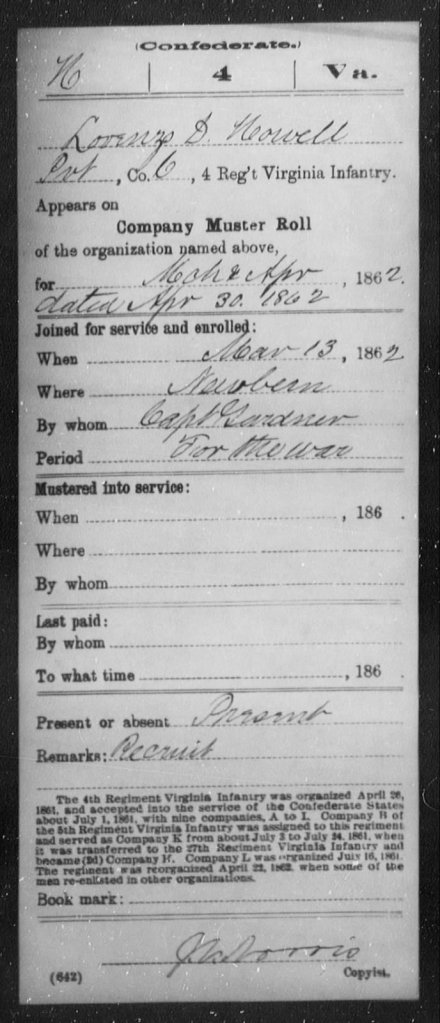
The 4th Virginia Infantry belonged to the Stonewall Brigade, associated with Thomas J. “Stonewall” Jackson. By the time Lorenzo joined, the regiment had already fought at First Manassas in July 1861. One of its earlier commanders was a man Lorenzo knew from a very different war: James Francis Preston.
A Remarkable Connection Between Two Wars
Preston had commanded Lorenzo’s company during the Mexican-American War. During the Civil War, Preston became colonel of the 4th Virginia Infantry and led the regiment at First Manassas.
Historian Michael M. Higgins has explored Preston’s possible association with the Confederate Rebel Yell. That proposed connection remains an interpretation, not a settled fact.
The stronger, documented connection is remarkable enough: Lorenzo’s Mexican-American War commander later led the very Confederate regiment Lorenzo would join. There is an essential chronological distinction, however. Preston died in January 1862, before Lorenzo enlisted in March. The two men did not serve together in the 4th Virginia during Lorenzo’s recorded Confederate service.
The Hardships Behind the Muster Rolls
Lorenzo’s Confederate records are not a continuous account of battlefield action. Instead, they document changing military status, repeated absences, and prolonged illness.
A November 1862 regimental return describes him as absent without leave beginning in May of that year. Later muster rolls repeatedly record him as absent sick, including references to Lexington, Virginia, and hospital care. The surviving records do not identify the illness.
Illness was a major burden for soldiers on both sides of the Civil War. Poor sanitation, exposure, inadequate nutrition, and infectious diseases could keep men away from their regiments for extended periods. Lorenzo’s muster rolls show how military service could be interrupted without describing everything that happened to the individual soldier.
A January–February 1864 roll records an absence without leave beginning December 26, 1863. By the March–April 1864 roll, Lorenzo was listed as present. Whatever difficulties had interrupted his service, he was again recorded with his company as a major campaign approached.
The Wilderness: May 5, 1864
In May 1864, Lieutenant General Ulysses S. Grant began the Overland Campaign against General Robert E. Lee’s Army of Northern Virginia. The opening battle unfolded in the dense woods of the Wilderness, where tangled vegetation, smoke, and difficult terrain made fighting especially confusing.
On May 5, Lorenzo was captured at the Wilderness. His prisoner-of-war record establishes the date and location, but does not say whether he was wounded, separated from his unit, surrounded, or captured in some other circumstance.
After more than two years on Confederate rolls, Lorenzo’s military experience entered its final phase. He was now a prisoner of war.
From the Wilderness to Point Lookout
Following his capture, Lorenzo was transported through Belle Plains, Virginia. On May 18, 1864, he arrived at Point Lookout, Maryland.
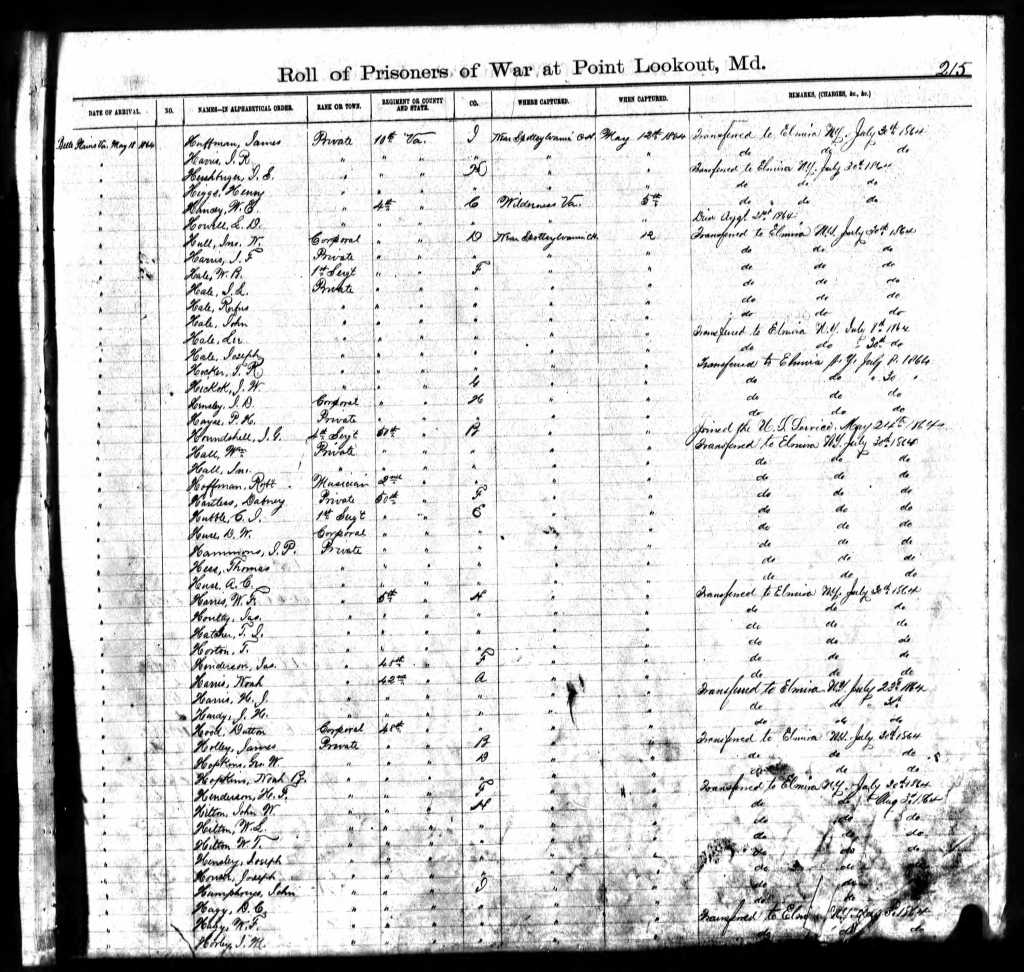
Point Lookout occupied a peninsula near the meeting of the Potomac River and Chesapeake Bay. Once a resort area, it became a large Union prison camp during the Civil War. Thousands of Confederate prisoners passed through it, facing crowded conditions, exposure, and disease.
Lorenzo had experienced prolonged illness earlier in his military service, but no record presented here establishes the cause of his death or links it to that earlier illness.
The final date is clear: August 21, 1864. Lorenzo died at Point Lookout a little more than three months after his capture. He was approximately thirty-eight years old. Mary and their children would never see him return home.
Remembered at Point Lookout
published register of Confederate prisoners who died at Point Lookout identifies “Howell, Lorenzo D.,” Company C, 4th Virginia, with the death date August 21, 1864. An interment report also preserves his name and military organization.
The Point Lookout Confederate memorial commemorates men who died in captivity. The surviving documentation does not establish the precise location of Lorenzo’s individual remains, but his name is preserved on the memorial.
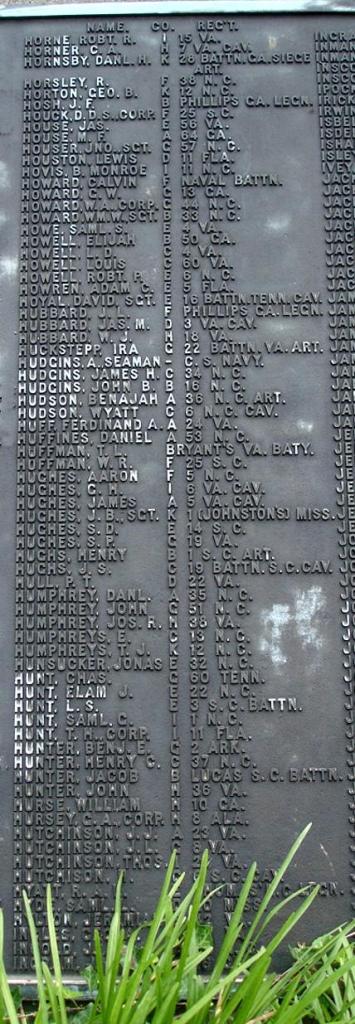
For a family historian, seeing that name on the memorial makes the records tangible. The index card, census, muster roll, and prisoner register describe different parts of a life. The memorial marks its ending.
A Family That Continued Beyond the War
Lorenzo’s death did not end the Howell family’s story. His children and siblings lived on, and later records continued to preserve his identity.
A 1930 Virginia death certificate for Fannie Donati identifies her parents as Lorenzo D. Howell and Mary McDonald. Fannie is the Francina recorded as a five-year-old in Lorenzo’s 1860 household. Decades after his death, a document from his daughter’s life still carried the names of her parents.
The marriage record identifies Lorenzo as a husband. The census and birth records reveal his work and household. The military documents trace his service in two wars, his capture, and his death. No single record tells the whole story; together they allow us to recover something of the person behind the name.
Two Wars, One Lifetime
Lorenzo Dow Howell’s lifetime connected two defining conflicts in American history. He served the United States during the Mexican-American War, returned to civilian life, and later joined the Confederate 4th Virginia Infantry. His records reveal the hardships of illness, the chaos of wartime capture, and death in captivity.
We cannot know from these documents everything Lorenzo believed, said, or experienced. We can, however, place him within his family, his community, and the events that changed the nation around him.
He was more than a name on a roster: he was a son, brother, husband, father, carpenter, veteran, and prisoner of war.
And his family’s connection to Point Lookout did not end with his death.
The Story Does Not End at Point Lookout
Lorenzo’s younger brother, Dillard Charles Howell (1842–1936), also served during the Civil War. Like Lorenzo, he became a prisoner of war at Point Lookout—but only after Lorenzo had died there.
The chronology is haunting. Lorenzo died at Point Lookout on August 21, 1864. Dillard was captured later and eventually imprisoned at that same Maryland camp. The brothers were never prisoners there together.
Unlike Lorenzo, Dillard survived the war. His life continued for decades, eventually taking him from Virginia to Kansas.
How did Dillard come to be held at the place where his older brother died? What do his military records reveal about his imprisonment, and where did his life lead after the war?
Those questions belong to the next chapter of the Howell family story.
Historical Context
Lorenzo’s life followed the nation from territorial expansion to civil war. The Mexican-American War added western lands to the United States and sharpened disputes over slavery’s expansion. Those disputes contributed to the sectional crisis that brought secession and the Civil War.
His service in the 4th Virginia Infantry placed him in the history of the Stonewall Brigade and, ultimately, Grant’s 1864 Overland Campaign. His muster rolls show the toll of illness on soldiers; his capture and death at Point Lookout connect his story to the wider experience of prisoners of war.
The experiences of Lorenzo and Dillard also show how the war reached into individual families. Two brothers from the same Virginia household were held at the same prison camp at different times, but only one returned home. Their records offer a personal view of a national conflict whose consequences lasted for generations.
Historical Note: This story is part of a continuing series exploring the Howell family’s military legacy across generations. It is based on family records, military records, historical sources, and documented family research. Some narrative details are included to place those records within their historical setting. Where surviving records do not establish an exact location, event, or circumstance, the narrative should be understood as historical context rather than a statement of documented fact.


Leave a Reply